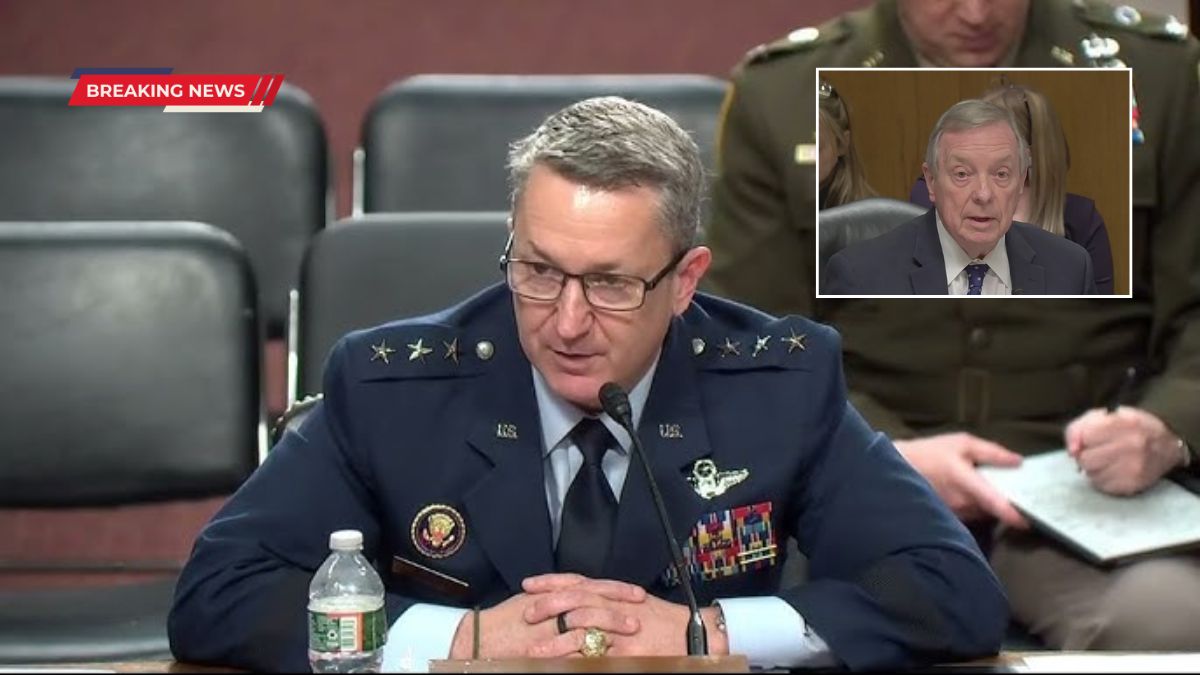
Senator Dick Durbin sharply questioned top military officials Tuesday over why the United States, despite spending more than a trillion dollars annually on defense, has been unable to fully reopen the Strait of Hormuz after weeks of disruption linked to Iran.
The exchange took place during a Senate Appropriations Subcommittee on Defense hearing reviewing the Trump administration’s proposed $1.5 trillion defense budget for fiscal year 2027.
Durbin directed his question to Joint Chiefs Chairman Gen. Dan Caine, focusing on the gap between America’s vast military resources and Iran’s comparatively low-cost strategy of disrupting one of the world’s most important shipping routes.
Exchange
Durbin framed the issue as both a military and financial contradiction.
“As we talk about trillion dollar plus budgets for our military, it appears that a very small budget is holding us hostage in the Straits of Hormuz,” the Illinois Democrat said during the hearing.
He then asked Caine directly why Iran still appeared capable of restricting maritime traffic despite recent U.S. military strikes and America’s unmatched defense spending.
Caine acknowledged the difficulty of the situation but emphasized the complexity of Iran’s tactics.
“It’s a complex situation out there with a lot of different small boats that are out there and other capabilities,” Caine said.
The general added that Iran was using the strait to pressure the global economy and urged Tehran to reconsider its actions.
Durbin, however, returned to the broader concern that massive military spending had not translated into clear operational control over a critical waterway.
Hearing Highlights
| Topic | Details |
|---|---|
| Senator Questioning | Dick Durbin |
| Pentagon Official | Gen. Dan Caine |
| Main Issue | Strait of Hormuz disruption |
| Pentagon Budget Request | $1.5 trillion |
| Estimated War Cost | $29 billion |
| Hearing Location | Dirksen Senate Office Building |
Strait
The Strait of Hormuz is one of the world’s most strategically important maritime chokepoints. Roughly one-fifth of global oil shipments pass through the narrow waterway connecting the Persian Gulf to international markets.
At its narrowest point, the strait measures about 21 miles wide, making it vulnerable to blockades and military disruption.
Military analysts have long warned that Iran’s strategy in the region does not depend on matching American military power directly. Instead, Tehran has spent decades developing lower-cost asymmetric tactics designed to complicate operations for larger naval forces.
These methods include:
- Sea mines
- Fast-attack boats
- Shore-based missile systems
- Drone swarms
- Commercial shipping harassment
This approach is often described by defense experts as Anti-Access/Area Denial, commonly known as A2/AD.
Strategy
Durbin’s criticism centered on whether America’s enormous defense investments are properly aligned with modern threats.
Iran’s annual military spending is estimated at roughly $10 billion, far below U.S. defense expenditures. Yet analysts say relatively inexpensive tools can still create major disruptions in confined waterways like the Strait of Hormuz.
The situation highlights a broader challenge facing advanced militaries. Expensive aircraft carriers, missile systems, and stealth technology may provide overwhelming strength in conventional warfare, but smaller asymmetric tactics can still create operational and economic pressure.
Strait of Hormuz Factors
| Iranian Tactics | US Challenges |
|---|---|
| Sea mines | Clearing shipping lanes |
| Small attack boats | Monitoring crowded waters |
| Drone operations | Constant air defense demands |
| Missile threats | Protecting commercial vessels |
Budget
The hearing occurred as lawmakers reviewed the administration’s proposed FY2027 defense budget, which includes large increases in military spending tied to ongoing operations in the Middle East.
Officials said the budget includes significant funding for replenishing weapons systems heavily used during the conflict, including:
- Tomahawk cruise missiles
- Patriot interceptors
- THAAD missile systems
- Precision Strike Missiles
According to congressional testimony, the conflict has already cost an estimated $29 billion.
Several lawmakers from both parties questioned whether the administration has clearly defined long-term goals for the operation.
Representative Rosa DeLauro criticized what she described as shifting objectives and inconsistent messaging surrounding the conflict.
Republican Representative Ken Calvert also raised concerns about the effect prolonged operations could have on American weapons stockpiles and military readiness.
Warning
During his testimony, Caine described the current security environment as a “delicate and dangerous time.”
He argued that sustained investment remains necessary to maintain readiness while U.S. forces continue operating at a high pace across multiple regions.
Still, his acknowledgment that Iran’s tactics present a genuine challenge drew attention because it appeared to reinforce Durbin’s broader point about the limits of military spending alone.
Defense analysts have increasingly debated whether future military planning should place greater emphasis on countering low-cost asymmetric threats rather than relying primarily on traditional power projection.
Debate
Durbin has been among the Senate’s more vocal critics of the current conflict with Iran. His comments Tuesday reflected growing bipartisan frustration over both the rising cost of the war and uncertainty surrounding its strategic direction.
The senator argued that larger Pentagon budgets do not automatically guarantee success against adversaries using unconventional methods specifically designed to exploit vulnerabilities in global trade routes.
The exchange lasted only a few minutes, but it highlighted a larger debate unfolding in Washington over military priorities, defense spending, and the effectiveness of modern warfare strategies.
As of Tuesday afternoon, shipping disruptions in the Strait of Hormuz continued, and lawmakers left the hearing without a clear explanation for when normal maritime traffic could fully resume.
FAQs
What did Durbin ask Gen. Caine?
He questioned why Iran can still disrupt the strait.
Why is the Strait of Hormuz important?
It handles a major share of global oil shipments.
What tactics is Iran using?

Sea mines, drones, missiles, and small boats.
How much has the conflict reportedly cost?
Lawmakers estimate costs at about $29 billion.
What is the Pentagon’s proposed budget?
The FY2027 request totals roughly $1.5 trillion.