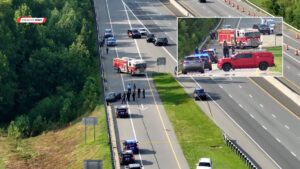

The Las Vegas Metropolitan Police Department (LVMPD) has adopted updated vehicle pursuit policies that allow officers to initiate or continue pursuits involving certain criminal suspects under expanded circumstances. The revised policy, which applies throughout Las Vegas and Clark County, Nevada, reflects the department’s effort to balance public safety with the need to apprehend individuals suspected of committing serious offenses.
Department leaders say the policy revisions provide officers with clearer guidance on when vehicle pursuits are appropriate while maintaining oversight and accountability. The changes come as law enforcement agencies nationwide continue evaluating pursuit policies to reduce unnecessary risks while ensuring dangerous offenders cannot simply evade arrest by fleeing in a vehicle.
Updated Policy Expands Pursuit Authority for Certain Cases
The revised LVMPD policy broadens the circumstances under which officers may pursue drivers suspected of committing specific crimes. Under previous guidelines, officers often had to carefully weigh the seriousness of the offense against the risks posed by a high-speed pursuit. The updated rules are intended to provide officers with greater flexibility when dealing with suspects believed to present a significant threat to public safety.
Police officials emphasized that the policy does not authorize unrestricted pursuits. Instead, officers must continue evaluating multiple factors before initiating or continuing a chase, including traffic conditions, weather, road design, pedestrian activity, time of day, and the potential danger to the public. Supervisors will continue monitoring pursuits and may order them terminated if the risks outweigh the law enforcement benefits.
Public Safety Remains a Central Consideration
Although the updated policy expands pursuit authority for certain categories of suspects, the department continues to stress that public safety remains its highest priority. Officers are trained to continually reassess conditions throughout a pursuit rather than relying solely on the seriousness of the suspected offense. If circumstances become too dangerous, officers are expected to discontinue the pursuit.
The revised policy also reinforces supervisory oversight throughout pursuit incidents. Communications personnel, field supervisors, and command staff may monitor active pursuits in real time, evaluate changing conditions, and provide direction regarding whether officers should continue, modify, or terminate the pursuit. This layered review is intended to improve decision-making during rapidly evolving incidents.
Policy Changes Reflect Evolving Law Enforcement Practices
Vehicle pursuit policies have become an important topic for police agencies across the United States as departments seek to reduce injuries while maintaining effective law enforcement. Many agencies have revised pursuit guidelines in recent years after reviewing collision data, legal standards, officer safety concerns, and community expectations regarding public accountability.
LVMPD officials indicated that the updated policy incorporates operational experience, legal developments, and lessons learned from previous incidents. Department leadership believes providing clearer standards can help officers make consistent decisions while ensuring that individuals suspected of serious criminal activity cannot automatically avoid arrest by fleeing in a vehicle.
Oversight, Training, and Community Expectations
The updated pursuit policy also places significant emphasis on officer training and post-incident review. Officers receive instruction on pursuit tactics, risk assessment, communication procedures, and alternatives that may reduce the need for prolonged vehicle chases. Training scenarios are designed to prepare officers for rapidly changing situations while reinforcing department policies and constitutional standards.
Following any vehicle pursuit, supervisors generally conduct reviews to evaluate compliance with department policy. Investigators may examine body-worn camera footage, dash camera recordings, radio communications, GPS data, and written reports to determine whether officers acted appropriately throughout the incident. These reviews help identify opportunities for additional training and ensure accountability within the department.
| Policy Overview | Details |
|---|---|
| Agency | Las Vegas Metropolitan Police Department (LVMPD) |
| Coverage Area | Las Vegas and Clark County, Nevada |
| Policy Change | Expanded authority for certain vehicle pursuits |
| Primary Objective | Balance suspect apprehension with public safety |
| Oversight | Supervisory monitoring and post-pursuit review |
| Current Status | Updated policy implemented |
The Las Vegas Metropolitan Police Department’s revised vehicle pursuit policy represents an effort to provide officers with greater flexibility when pursuing certain criminal suspects while maintaining strong safeguards designed to protect the public. By expanding pursuit authority under defined circumstances and reinforcing supervisory oversight, the department aims to improve both operational effectiveness and accountability.
As the updated policy is implemented across Las Vegas and Clark County, Nevada, department leadership will likely continue monitoring pursuit outcomes, officer compliance, and public safety data. Future evaluations may determine whether additional adjustments are necessary, but officials maintain that every pursuit must continue to be guided by careful risk assessment, sound judgment, and the overarching goal of protecting both officers and the community.
FAQ’s:
What changed in the LVMPD vehicle pursuit policy?
The updated policy allows officers to pursue certain criminal suspects under broader circumstances while continuing to require ongoing risk assessments and supervisory oversight.
Where does the new policy apply?
The revised policy applies to the Las Vegas Metropolitan Police Department, which serves Las Vegas and Clark County, Nevada.
Does the policy allow officers to pursue every fleeing vehicle?
No. Officers must still evaluate factors such as traffic, weather, pedestrian activity, road conditions, and overall public safety before initiating or continuing a pursuit.
How are vehicle pursuits supervised?
Active pursuits are monitored by supervisors and communications personnel, who can direct officers to continue or terminate a pursuit depending on changing conditions. Completed pursuits are also subject to departmental review.
Why did LVMPD update the policy?
The department said the revisions are intended to better balance public safety, officer decision-making, and the need to apprehend suspects involved in serious criminal activity, while maintaining accountability through training and supervisory oversight.