
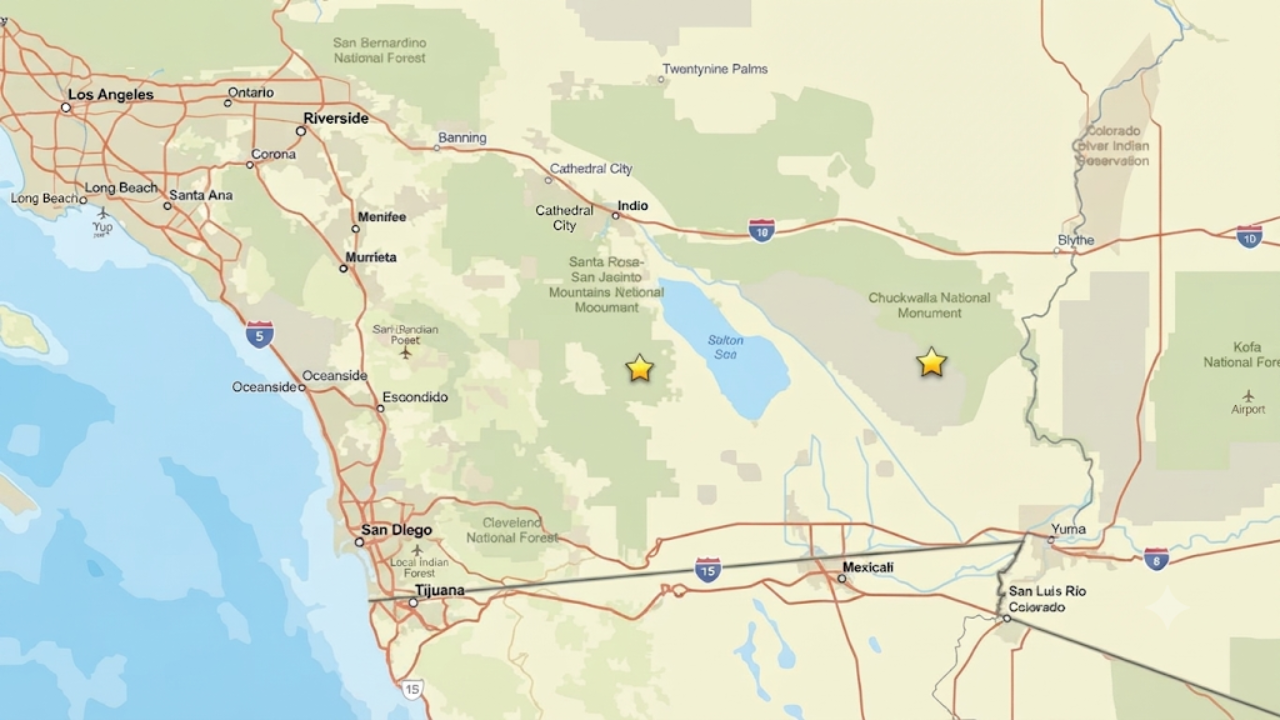
Ocotillo Wells, San Diego County, California, USA — A magnitude 2.0 earthquake was recorded near Ocotillo Wells in San Diego County, California, on July 2, according to seismic monitoring agencies. The minor earthquake was detected by instruments that continuously monitor earthquake activity throughout California. No immediate reports of injuries, structural damage, or service disruptions were associated with the seismic event.
Small earthquakes of this magnitude are relatively common in California because the state sits atop an active network of geological faults. Although a magnitude 2.0 earthquake is generally too weak to cause significant damage, each recorded event contributes valuable scientific information that helps researchers better understand regional fault systems and ongoing seismic activity.
Emergency officials did not issue evacuation orders or public safety alerts following the earthquake, and normal activities continued throughout the surrounding communities. Authorities encouraged residents to remain familiar with earthquake preparedness measures, noting that California experiences thousands of earthquakes each year, most of which are too small to be widely felt.
The event serves as another reminder of California’s active seismic environment and the importance of maintaining emergency readiness.
Minor Earthquake Recorded Near Ocotillo Wells
According to seismic monitoring data, the earthquake occurred near Ocotillo Wells, San Diego County, an area located in Southern California that regularly experiences low-level seismic activity. Instruments detected the event shortly after it occurred, allowing scientists to calculate its estimated magnitude, location, and depth.
Earthquakes measuring around magnitude 2.0 typically produce very light ground motion and may only be felt by individuals located close to the epicenter. Many earthquakes of this size pass unnoticed by nearby residents unless they occur at shallow depths or directly beneath populated areas.
Scientists routinely analyze these events to monitor changes in regional seismic activity. Every recorded earthquake, regardless of size, adds information that helps improve understanding of local fault behavior and long-term earthquake patterns.
No aftershocks requiring public notification were immediately reported following the event.
No Immediate Damage or Injuries Reported
Authorities reported no immediate indications of injuries, damaged buildings, road closures, or utility interruptions resulting from the earthquake. Local emergency services did not announce any significant emergency response associated with the seismic event.
Minor earthquakes such as this generally do not generate enough ground shaking to damage infrastructure. Nevertheless, emergency management officials continue encouraging residents to report any unusual structural issues if they believe damage has occurred following an earthquake.
Public agencies also monitor transportation systems, bridges, utilities, and other critical infrastructure after seismic events to ensure public safety. In this case, there were no reports suggesting that essential services had been affected.
Officials emphasized that the absence of reported damage is consistent with earthquakes of relatively low magnitude.
California’s Active Seismic Landscape
California experiences frequent earthquakes because it lies along several major fault systems, including the well-known San Andreas Fault and numerous additional regional faults. Thousands of earthquakes are recorded statewide each year, although only a small percentage are strong enough to cause damage or widespread public concern.
Most recorded earthquakes measure below magnitude 3.0 and are detected only through sophisticated seismic monitoring equipment. Scientists use these smaller events to map underground fault activity and identify trends that may improve future hazard assessments.
While it is impossible to predict exactly when larger earthquakes will occur, continuous monitoring helps emergency agencies maintain situational awareness and rapidly communicate important information to the public.
Researchers stress that every earthquake contributes to a broader understanding of California’s complex geological environment.
Preparedness Remains Essential
Although the July 2 earthquake caused no reported damage, emergency officials continue encouraging Californians to prepare for future earthquakes. Preparedness recommendations include assembling emergency supply kits, securing heavy furniture, identifying safe locations inside homes and workplaces, and developing family communication plans.
Residents are advised to practice the “Drop, Cover, and Hold On” safety procedure, which remains the recommended protective action during earthquake shaking. Officials also encourage households to keep sufficient food, water, medications, flashlights, batteries, and first-aid supplies available in case larger earthquakes disrupt services.
Preparedness efforts are particularly important because earthquakes occur without warning. Communities that regularly practice emergency planning generally recover more effectively from significant seismic events.
Authorities continue reminding the public that preparedness is one of the most effective ways to reduce earthquake-related risks.
Earthquake Overview
| Category | Details |
|---|---|
| Event | Earthquake |
| Magnitude | 2.0 |
| Date | July 2 |
| Location | Near Ocotillo Wells, San Diego County, California, USA |
| Reported Damage | None immediately reported |
| Reported Injuries | None immediately reported |
| Emergency Alerts | None issued |
| Monitoring Agency | Seismic monitoring authorities |
| Public Impact | Minimal |
| Current Status | No significant impacts reported |
The magnitude 2.0 earthquake recorded near Ocotillo Wells in San Diego County represents another example of California’s ongoing seismic activity. While the earthquake was minor and caused no reported injuries or property damage, it provided valuable data for scientists monitoring the state’s active fault systems. Such events occur regularly throughout California and play an important role in improving geological research and earthquake hazard assessment.
Although this earthquake had minimal public impact, emergency officials continue emphasizing the importance of preparedness. Earthquakes cannot be predicted, making emergency planning, public education, and resilient infrastructure essential components of California’s approach to managing seismic risk. Residents are encouraged to remain informed about earthquake safety practices and maintain emergency supplies to ensure readiness for future seismic events of any size.
FAQ’s:
Where did the earthquake occur?
The earthquake was recorded near Ocotillo Wells, San Diego County, California, USA.
How strong was the earthquake?
The earthquake had a reported magnitude of 2.0.
Were there any injuries or damage?

Authorities reported no immediate injuries or property damage.
Are earthquakes common in California?
Yes. California experiences thousands of earthquakes each year because of its active fault systems.
What should residents do during an earthquake?
Emergency officials recommend following the “Drop, Cover, and Hold On” procedure and maintaining an emergency preparedness kit.