
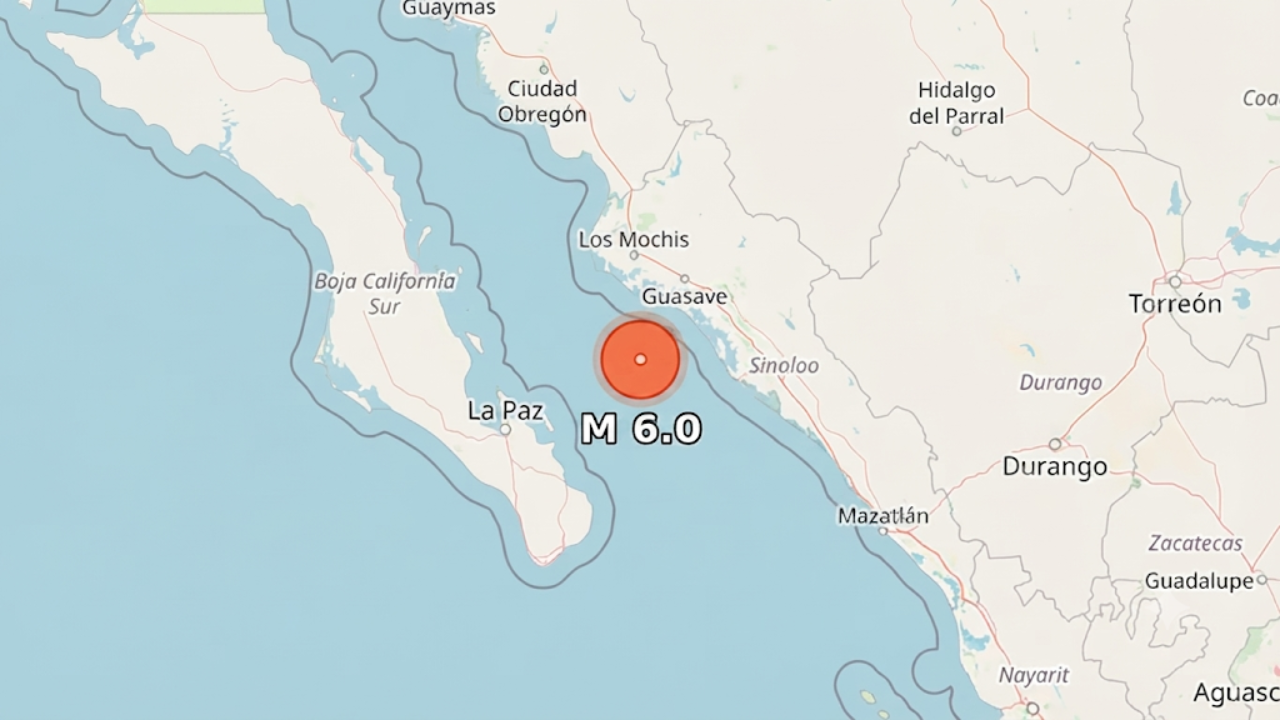
Gulf of California, Mexico — A magnitude-6.0 earthquake was recorded in the Gulf of California off the coast of Mexico, according to seismic monitoring agencies. The earthquake occurred beneath the waters separating the Baja California Peninsula from mainland Mexico, prompting authorities and scientists to monitor the region for any aftershocks or potential hazards. Initial reports indicated that the quake was felt in parts of northwestern Mexico, while residents in some areas of the southwestern United States also reported light shaking.
Emergency officials began assessing the situation shortly after the earthquake was detected. As of the latest available information, there were no immediate reports of widespread damage, fatalities, or serious injuries directly linked to the seismic event. Authorities continued evaluating infrastructure and monitoring seismic activity as precautionary measures.
The earthquake serves as another reminder of the active tectonic environment surrounding the Gulf of California, one of North America’s most seismically active regions.
Earthquake Detected in a Seismically Active Region
The earthquake originated beneath the Gulf of California, a narrow body of water located between the Baja California Peninsula and mainland Mexico. The region lies along a complex tectonic boundary where the Pacific Plate and the North American Plate interact, producing frequent earthquakes of varying magnitudes.
Seismologists explain that movement along numerous faults beneath the gulf regularly generates seismic activity. While many earthquakes in the area are too small to be widely felt, stronger events such as this magnitude-6.0 quake attract closer attention because they can produce noticeable ground shaking across a broad geographic area.
Scientists continue analyzing the earthquake’s depth, epicenter, and fault mechanism to better understand how the event occurred and whether additional seismic activity may follow.
Authorities Monitor Aftershocks and Public Safety
Following the earthquake, emergency management agencies and geological monitoring organizations closely watched for aftershocks, which commonly occur after moderate and strong earthquakes. Aftershocks may continue for hours, days, or even weeks depending on the characteristics of the main event.
Officials encouraged residents in affected regions to remain alert, review emergency preparedness plans, and follow instructions issued by local authorities if additional seismic activity occurs.
At the time of reporting, there were no tsunami warnings associated with the earthquake, and authorities stated that no immediate coastal evacuation orders had been issued.
Emergency responders also began checking transportation infrastructure, utilities, and public facilities to determine whether the earthquake caused any structural damage requiring attention.
Why the Gulf of California Experiences Frequent Earthquakes
The Gulf of California forms part of an active geological system where tectonic plates gradually move relative to one another. Over time, stress accumulates along faults before being released suddenly during earthquakes.
Researchers have long studied the region because it represents an important transition zone connecting the San Andreas Fault system in California with spreading centers beneath the Gulf of California.
Earthquakes occurring offshore often reduce the likelihood of severe structural damage compared with shallow earthquakes directly beneath densely populated urban centers. However, offshore earthquakes are still carefully monitored because their effects depend on factors including depth, magnitude, distance from population centers, and local geological conditions.
Scientists emphasize that earthquakes cannot currently be predicted, making preparedness an essential component of public safety in earthquake-prone regions.
Ongoing Assessment Continues
Seismic monitoring agencies continue collecting information regarding the earthquake while local authorities evaluate conditions in nearby communities. Engineers and emergency officials may conduct inspections of critical infrastructure, including roads, bridges, ports, public buildings, and utilities if necessary.
Residents are encouraged to remain informed through official government updates and to report significant damage to local emergency authorities should new information emerge.
Experts also remind the public to maintain emergency supplies, secure heavy household furniture, and practice earthquake safety procedures such as “Drop, Cover, and Hold On” during future seismic events.
Although no major impacts were immediately reported, monitoring efforts remain ongoing as scientists continue evaluating aftershock activity and any additional developments.
Earthquake Overview
| Category | Details |
|---|---|
| Incident | Magnitude-6.0 earthquake |
| Location | Gulf of California, Mexico |
| Magnitude | 6.0 |
| Region | Between Baja California Peninsula and mainland Mexico |
| Type | Offshore earthquake |
| Immediate Reports | No widespread damage or fatalities immediately reported |
| Tsunami Warning | No immediate tsunami warning reported |
| Response | Authorities monitoring aftershocks and conducting assessments |
| Geological Cause | Movement along active tectonic plate boundary |
| Current Status | Ongoing monitoring and evaluation |
The magnitude-6.0 earthquake recorded in the Gulf of California highlights the ongoing seismic activity that characterizes one of North America’s most geologically active regions. While the offshore location helped reduce the immediate risk to populated areas, authorities continued monitoring for aftershocks and assessing infrastructure to ensure public safety.
Scientists emphasize that earthquakes remain a natural part of the tectonic processes shaping the Gulf of California and surrounding regions. Continued monitoring, emergency preparedness, and public awareness remain essential for communities living in earthquake-prone areas of both Mexico and the southwestern United States.
FAQ’s:
Where did the earthquake occur?
The earthquake occurred in the Gulf of California, Mexico, between the Baja California Peninsula and mainland Mexico.
How strong was the earthquake?
Seismic monitoring agencies reported the earthquake had a magnitude of 6.0.
Were there reports of major damage?

As of the latest available information, there were no immediate reports of widespread damage, fatalities, or serious injuries.
Was a tsunami warning issued?
No immediate tsunami warning was reported following the earthquake.
Why does the Gulf of California experience frequent earthquakes?
The region sits along an active tectonic boundary where the Pacific Plate and North American Plate interact, making it one of the most seismically active areas in North America.