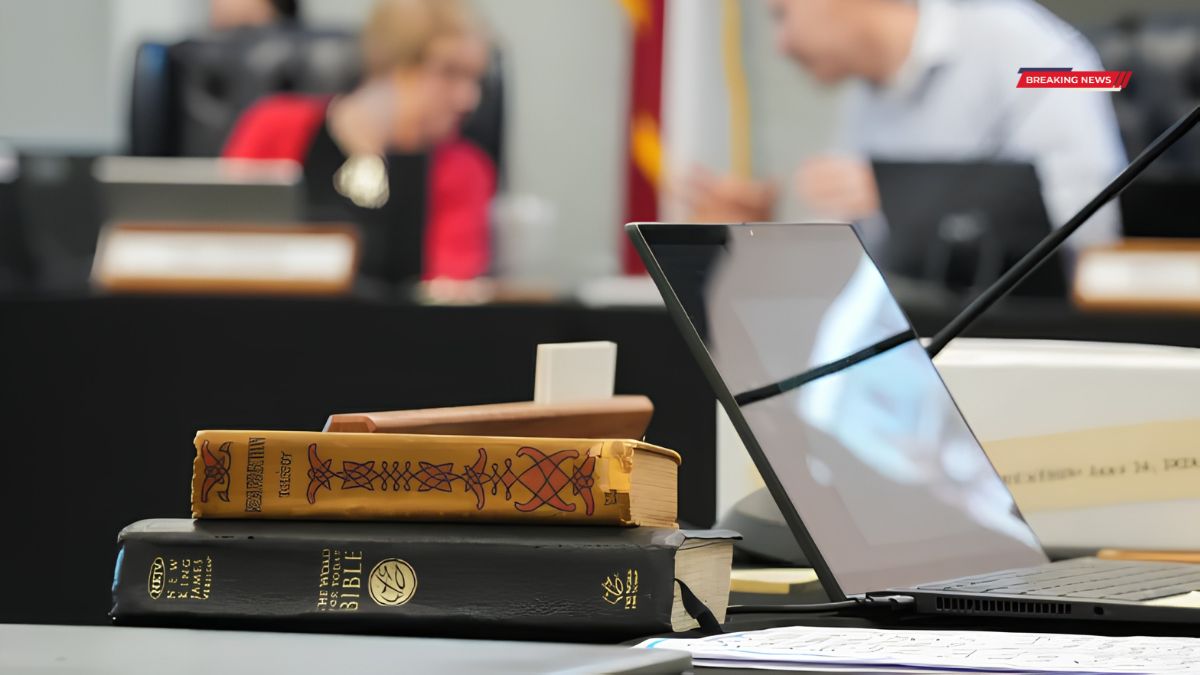
Texas public school students will be required to read Bible stories under a new statewide reading list approved Friday by the Texas State Board of Education, a move that expands conservative efforts to bring Christian teachings into public classrooms.
The decision, approved by the Republican-controlled board, comes despite months of criticism from educators, parents, and civil rights groups who argue the list lacks diversity and blurs the constitutional separation between church and state.
Decision
Under the newly approved mandate, more than 5 million public school students in Texas will be required to read from a fixed list of literary works. Alongside traditional titles such as E.B. White’s Charlotte’s Web and Charles Dickens’ Great Expectations, the list includes Bible stories and passages from the New Testament and the Book of Job.
The rollout will be gradual, beginning with elementary school students in 2030 and expanding to higher grade levels in later years.
While teachers may still assign additional books, the required list limits their discretion over core reading materials, a shift from the long-standing practice of leaving book selection largely to educators and local districts.
Pushback
Opponents argue the mandate prioritizes Christianity over other faiths and nonreligious perspectives in a public education system that serves students from diverse backgrounds.
Elva Mendoza of the Texas Freedom Network said the policy sends a message that only one religious tradition is worthy of inclusion. She noted that Texas schools educate children of many faiths and beliefs and should reflect that diversity in their curricula.
Critics also object to the state dictating reading choices, calling it an erosion of teacher autonomy and local control.
Support
Supporters of the move argue that Judeo-Christian traditions played a foundational role in American history and deserve a place in public education. Some parents and community members praised the board for reinforcing what they view as moral and cultural values.
Brooke Mazel, a retiree from Lubbock, told the board that Christian teachings helped shape her family’s values and said public schools should reflect what she called America’s Christian roots.
Scope
The approved list includes around 200 texts, far exceeding the minimum requirement set by a 2023 state law that mandated at least one literary work per grade level.
Elementary students would read picture-book versions of stories such as David and Goliath and Daniel and the Lion’s Den. By fourth grade, students would encounter passages from the New Testament about Jesus.
Middle school students would read several biblical passages, including excerpts from Jesus’ sermons. High school students would be required to read Bible passages as supplemental material alongside classic literature, including works by Charles Dickens and Jane Austen’s Pride and Prejudice.
Unusual Step
Education experts say Texas stands apart nationally. Antero Garcia, president of the National Council of Teachers of English, said he is not aware of any other state that mandates religious texts on a required reading list.
PEN America’s Kasey Meehan described the move as unique and warned that it functions like indirect censorship by crowding out diverse voices and perspectives.
Broader Trend
The reading list is part of a broader push in Texas to expand religion’s role in public schools. The state already allows school districts to hire chaplains, requires the Ten Commandments to be displayed in classrooms, and has approved an optional Bible-infused curriculum.
The board is also expected to vote on a social studies curriculum that connects Bible stories with American history, further fueling debate over how religion should be taught in public education.
Debate
Teachers and advocacy groups warn that strict reading mandates reduce exposure to diverse authors and cultures. Frank Strong, a Texas teacher and co-founder of Texas Freedom to Read, said students benefit from seeing both themselves and others reflected in what they read.
He and others questioned why the state needs to mandate books even at the kindergarten level, arguing that educators should be trusted to choose age-appropriate materials.
As Texas moves forward with the new reading requirements, the policy is likely to face continued scrutiny and possible legal challenges, especially as other states watch to see whether Texas becomes a model or an outlier.
FAQs
What did the Texas board approve?
A required reading list that includes Bible stories.
When will the changes begin?
The rollout starts with elementary students in 2030.
Are teachers allowed other books?

Yes, teachers can assign additional readings.
Why are critics opposing the move?
They say it lacks diversity and blurs church-state lines.
Is Texas alone in doing this?
Experts say no other state has a similar mandate.