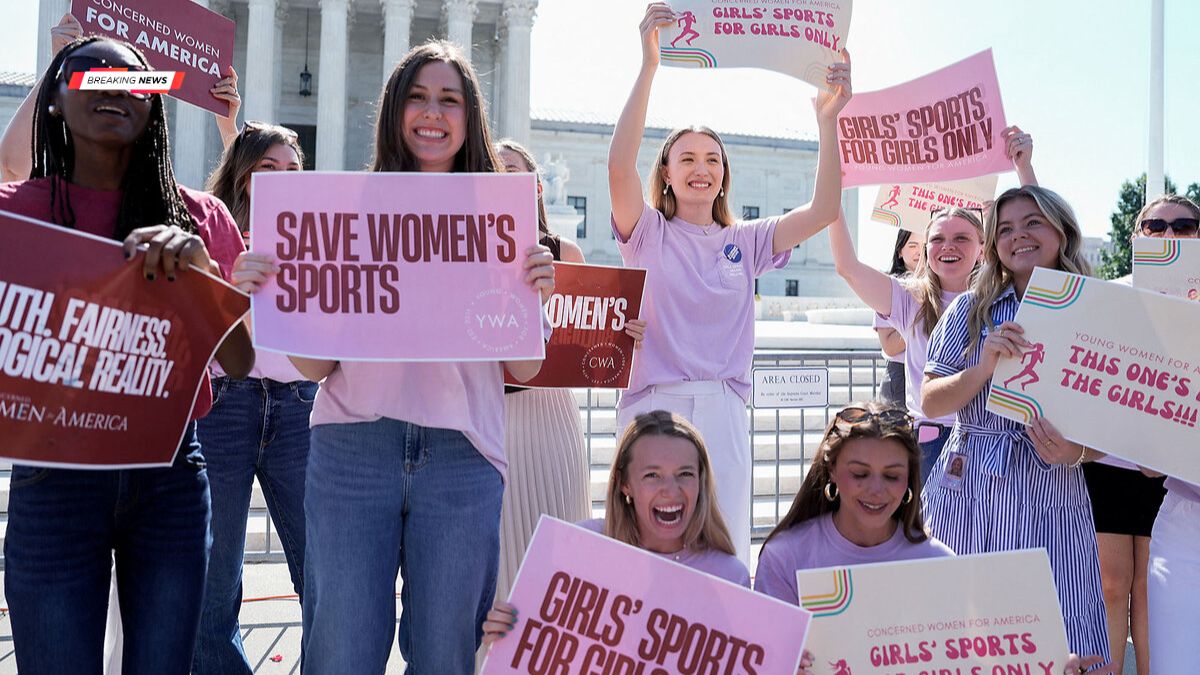
The Supreme Court on Tuesday ruled that states may prohibit transgender athletes from competing on girls’ and women’s sports teams, upholding laws from West Virginia and Idaho and delivering a major ruling on the scope of Title IX and the Constitution’s Equal Protection Clause.
In a pair of closely watched cases, West Virginia v. B.P.J. and Little v. Hecox, the court sided with the states, concluding that eligibility for women’s and girls’ sports may be based on biological sex.
The Court’s Decision
Writing for the majority, Justice Brett Kavanaugh said the Constitution and Title IX allow states to maintain separate sports teams for biological females.
“Consistent with Title IX and the Equal Protection Clause, we hold that the States may maintain women’s and girls’ sports for biological females,” Kavanaugh wrote. “The Constitution and Title IX do not require an overhaul of women’s and girls’ sports throughout America.”
The court ruled that states may determine eligibility for girls’ and women’s teams based on sex assigned at birth. The three liberal justices dissented on the Equal Protection analysis but agreed with the majority that Title IX does not require states to allow transgender athletes to compete on teams that align with their gender identity.
Impact Nationwide
The ruling effectively protects similar laws enacted in at least 27 states over the past several years. Those measures were passed largely in response to public debate and high-profile cases involving transgender athletes competing in girls’ and women’s sports.
President Trump also weighed in on the issue last year, signing an executive order barring schools that receive federal funding from allowing transgender girls and women to compete on teams consistent with their gender identity.
Beyond government policy, major sports organizations have made similar changes. The NCAA and the International Olympic Committee have revised eligibility rules to limit women’s competitions to athletes assigned female at birth.
The West Virginia Case
West Virginia’s law, known as the Save Women’s Sports Act, was passed in 2021. It requires school athletic teams to be designated by biological sex and bars students assigned male at birth from participating in girls’ and women’s sports.
The case was brought by Becky Pepper-Jackson, a transgender girl who sought to compete on her school’s girls’ cross-country and track teams. Pepper-Jackson began socially transitioning in elementary school and has received puberty-delaying medication and hormone therapy. She is currently a high school student.
A federal district court upheld the law, but a federal appeals court later ruled that it unlawfully discriminated against Pepper-Jackson. The Supreme Court reversed that decision, finding the law permissible under Title IX and the Constitution.
State officials argued the law draws lawful distinctions between the sexes and is substantially related to protecting competitive fairness in girls’ and women’s sports.
The Idaho Case
The Supreme Court also upheld Idaho’s law, the first in the nation to ban transgender athletes from participating in girls’ and women’s sports.
The case was brought by Lindsay Hecox, who challenged the law after attempting to compete on women’s track and cross-country teams at Boise State University. A federal appeals court had previously ruled the law was likely unconstitutional, but the Supreme Court disagreed, siding with the state.
Broader Legal Context
Title IX, enacted more than 50 years ago, prohibits sex discrimination in federally funded education programs. Regulations adopted shortly after its passage explicitly allow sex-separated athletic teams, as well as separate locker rooms and restrooms, provided schools offer equal athletic opportunities.
The ruling is part of a series of recent Supreme Court cases involving transgender rights. Last term, the court upheld a Tennessee law restricting certain medical treatments for minors with gender dysphoria, a type of law now in place in about half the states.
At the same time, the court has previously expanded protections in other areas. In 2020, it ruled that Title VII of the Civil Rights Act prohibits employers from firing workers based on sexual orientation or transgender status.
Tuesday’s decision clarifies that, in the context of school athletics, states may rely on biological sex when setting eligibility rules for girls’ and women’s teams.
FAQs
What did the Supreme Court rule?
States may bar transgender athletes from girls’ and women’s teams.
Which states’ laws were upheld?
Laws from West Virginia and Idaho.
What was the court’s vote split?

The decision was issued by a 6-3 majority.
How many states have similar bans?
At least 27 states have enacted similar laws.
Does the ruling affect all transgender rights?
No, it applies specifically to sports eligibility.