
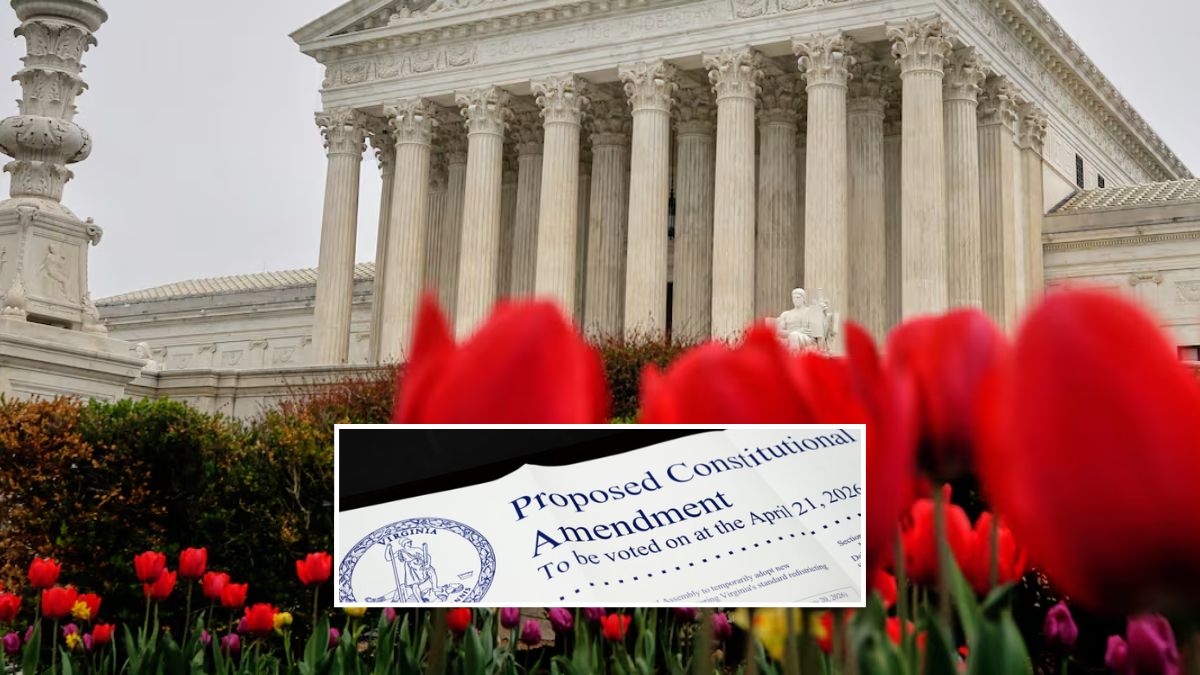
Democrats have asked the U.S. Supreme Court to halt a Virginia court ruling that invalidated a recently approved constitutional amendment tied to congressional redistricting. The emergency appeal marks another development in the broader national debate over congressional maps and election law ahead of future House races.
The appeal was filed after the Virginia Supreme Court ruled 4-3 that the ballot measure violated state constitutional procedures. The amendment, which voters narrowly approved last month, could have led to new congressional districts viewed as more favorable to Democrats in several regions of the state.
The dispute has drawn national attention because it comes during an active period of mid-decade redistricting efforts across multiple states. It also follows recent Supreme Court decisions affecting voting rights and district boundaries.
Background
The Virginia constitutional amendment was designed to allow changes to congressional district maps that could potentially create four additional competitive House seats. Democrats argued that the proposal was part of a broader response to Republican-led redistricting efforts in states such as Texas, Florida, Ohio, Missouri, and North Carolina.
However, the Virginia Supreme Court ruled that lawmakers failed to follow proper constitutional timing requirements. According to the majority opinion, the process of placing the amendment on the ballot began after early voting had already started in the previous election cycle.
State judges concluded that this timing issue made the amendment invalid under Virginia law.
Democrats disagreed with that interpretation and argued that elections legally conclude on Election Day itself, even if early voting is underway beforehand. They cited prior U.S. Supreme Court rulings in support of that argument but were unsuccessful in the state court.
The emergency appeal now asks the U.S. Supreme Court to temporarily block the Virginia ruling while the legal challenge continues.
National Context
The Virginia dispute is part of a larger national discussion about redistricting and political representation. Over the past year, several states have revisited congressional maps outside the traditional once-a-decade census process.
President Donald Trump encouraged Republican-controlled legislatures to pursue mid-decade redraws in states where population shifts or legal opportunities could improve Republican electoral prospects.
At the same time, Democrats have explored map changes in states where they hold political influence. The competition reflects how closely divided the U.S. House of Representatives remains and how district boundaries can affect election outcomes.
The issue became more significant after a recent Supreme Court ruling weakened key provisions of the Voting Rights Act. Civil rights groups and voting advocates argued that the decision could reduce protections for minority voters in some districts.
Several Southern states have since reviewed majority-Black districts and other maps previously shaped by federal voting protections.
| Key Development | Details |
|---|---|
| Virginia Court Vote | 4-3 ruling |
| Amendment Purpose | Adjust congressional districts |
| Main Legal Question | Timing of ballot procedures |
| Democratic Position | Election ends on Election Day |
| Current Status | Appeal filed with U.S. Supreme Court |
Legal Challenges
Legal experts note that Democrats face a difficult path at the Supreme Court. The justices generally avoid overturning state court decisions that interpret state constitutions.
That principle was highlighted in 2023 when the Supreme Court declined to reverse a North Carolina state court ruling involving congressional maps supported by Republicans.
Because of this history, the Virginia appeal is viewed as a legal challenge with uncertain prospects.
Still, the case raises broader constitutional questions about election procedures, early voting timelines, and the role of state courts in determining ballot access rules.
The Supreme Court has increasingly become involved in election-related disputes in recent years, particularly those connected to redistricting, voting rights, and ballot measures.
Political Impact
The Virginia amendment briefly changed expectations surrounding national redistricting efforts. Political analysts had viewed the measure as a possible counterbalance to Republican-backed maps in several other states.
If implemented, the proposal could have improved Democratic opportunities in future congressional elections by creating additional competitive districts.
The Virginia Supreme Court ruling altered those calculations and renewed concerns among Democrats about the legal landscape surrounding election law and district boundaries.
Republicans, meanwhile, have defended many recent redistricting efforts as lawful exercises of state authority.
The debate reflects a broader political reality in which both major parties closely monitor congressional maps because even small district changes can influence House control.
| State | Recent Redistricting Activity |
|---|---|
| Texas | Republican-led map discussions |
| Florida | New congressional map approved |
| Ohio | Redistricting debates continue |
| North Carolina | Ongoing legal disputes |
| Virginia | Amendment invalidated by court |
Court Structure
Virginia’s Supreme Court is not widely viewed as strongly aligned with either political party. Justices are appointed by the state legislature, which has shifted between Democratic and Republican control over the years.
That structure has contributed to the perception that the court’s decisions are less ideologically predictable than some federal court rulings.
In the current case, the narrow 4-3 split reflected disagreement among the justices over how election timing rules should be interpreted under the state constitution.
The divided ruling also increased attention on whether federal courts should become involved in disputes centered on state constitutional procedures.
Broader Debate
Redistricting has remained a recurring source of political and legal conflict in the United States for decades. Supporters of redraw efforts often argue that maps should evolve alongside population changes and shifting communities.
Critics argue that heavily partisan maps can reduce electoral competition and weaken voter influence.
The recent weakening of the Voting Rights Act has added further complexity to these debates. Advocacy groups have warned that some district changes could reduce minority representation in Congress.
At the same time, courts continue to face questions about how much authority they should exercise over political mapmaking.
The Virginia case now stands as another important test involving election law, state constitutional authority, and congressional representation. Whether the U.S. Supreme Court decides to intervene may shape not only Virginia’s political landscape but also future redistricting disputes nationwide.
FAQs
Why did Democrats file an appeal?
They want the amendment restored.
What did Virginia’s court decide?
The ballot process violated timing rules.
How many seats could change?

Four congressional seats were discussed.
Why is redistricting important?
District maps affect election outcomes.
Is the Supreme Court likely to act?
Legal experts say the outcome is uncertain.















Ariana Grande Plans Break From Public Spotlight After Tour Amid Ongoing Scrutiny