
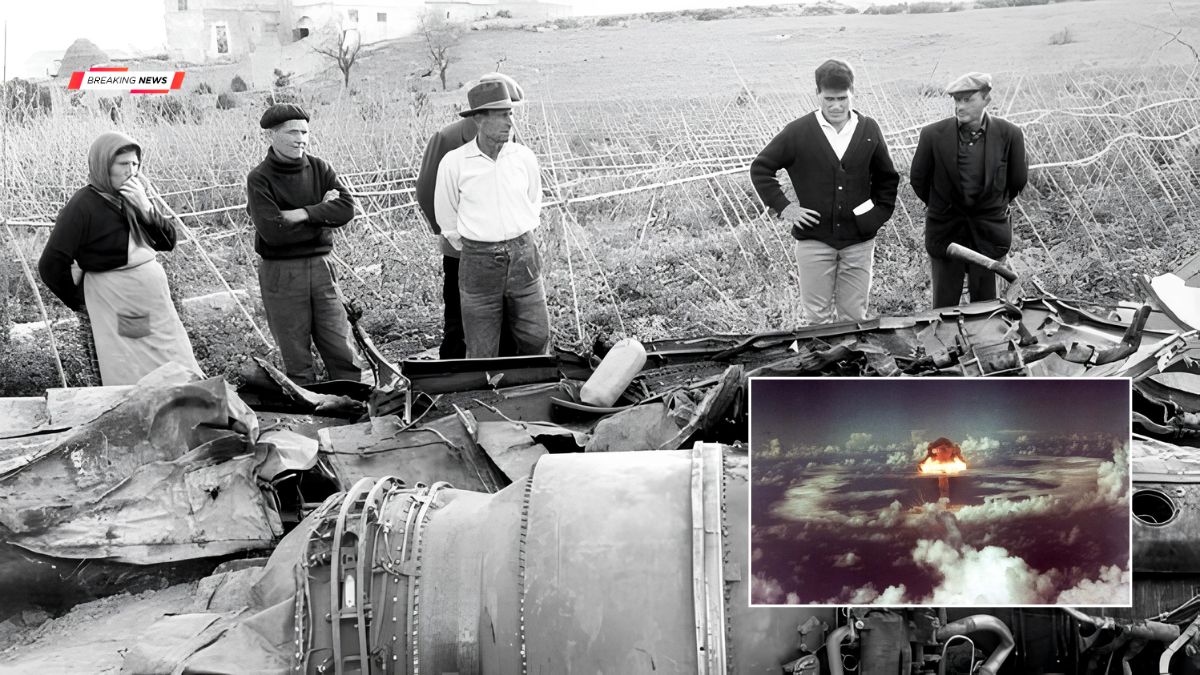
The Cold War was marked by a relentless competition between the United States and the Soviet Union to build increasingly powerful nuclear weapons. As both nations rushed to strengthen their military capabilities, they often accepted significant risks in training and testing.
One of the most remarkable examples occurred on March 11, 1958, when the US Air Force accidentally dropped a Mark 6 nuclear bomb on the small town of Mars Bluff, South Carolina. Although the weapon did not trigger a nuclear explosion, the incident demonstrated just how dangerous Cold War military operations could be.
Background
The end of World War II did not bring an end to America’s nuclear weapons program. After using Little Boy and Fat Man against Hiroshima and Nagasaki in 1945, the United States continued developing more advanced atomic weapons to maintain its military advantage during the Cold War.
As tensions with the Soviet Union increased, nuclear deterrence became a central part of American defense strategy. The Air Force regularly conducted realistic training exercises, sometimes carrying live nuclear weapons without their nuclear cores. These exercises were designed to prepare crews for actual combat missions but also introduced serious risks.
Development
The Mark 6 nuclear bomb was developed from the design of the Fat Man bomb that devastated Nagasaki. Manufactured between 1951 and 1955, it became one of the most widely produced nuclear weapons in the early US arsenal.
More than 1,000 Mark 6 bombs were built in different versions, offering varying explosive yields to meet military requirements. The weapon remained in active service until 1962 and played an important role during the early years of the Cold War.
| Feature | Details |
|---|---|
| Bomb Name | Mark 6 Nuclear Bomb |
| Based On | Fat Man (Nagasaki bomb) |
| Production Period | 1951-1955 |
| Units Produced | Over 1,000 |
| Service Period | Until 1962 |
Mission
On March 11, 1958, a Boeing B-47 Stratojet belonging to the 375th Bombardment Squadron of the 308th Bombardment Wing departed Hunter Army Airfield during Operation Snow Flurry. The exercise simulated nuclear bombing missions over the United Kingdom and North Africa.
Before takeoff, technicians discovered that the locking mechanism securing the Mark 6 bomb was malfunctioning. To keep the weapon in place, they used a sling to force a steel safety pin into position. Although the aircraft departed successfully, the faulty restraint system would soon create a dangerous situation.
Accident
While flying at an altitude of approximately 15,000 to 20,000 feet, Captain Bruce Kulka, serving as navigator and bombardier, attempted to inspect the malfunctioning restraint system. During the inspection, he accidentally activated the emergency release lever.
The Mark 6 bomb immediately fell from the aircraft toward the ground below. Kulka himself nearly fell through the open bomb bay but managed to hold onto the aircraft and pull himself back inside.
The bomb landed in the backyard of the Gregg family in Mars Bluff, South Carolina.
Explosion
Fortunately, the bomb was not equipped with its plutonium core, which had been stored separately inside the aircraft. As a result, a nuclear explosion was impossible.
However, the weapon still contained powerful conventional explosives. Upon impact, the TNT detonated, producing a massive blast that created a crater roughly 70 feet wide.
The explosion destroyed the Gregg family’s children’s playhouse, damaged several nearby homes, shattered windows across the area, and injured six members of the Gregg family. Despite the force of the explosion, no one was killed.
| Incident Details | Information |
|---|---|
| Date | March 11, 1958 |
| Location | Mars Bluff, South Carolina |
| Aircraft | Boeing B-47 Stratojet |
| Bomb | Mark 6 Nuclear Bomb |
| Nuclear Core | Not Installed |
| Result | Conventional explosion only |
| Fatalities | None |
| Injuries | Six family members |
Response
Military personnel quickly arrived at the accident scene to secure the area and investigate what had happened. Officials confirmed that the plutonium core had never been installed, preventing a catastrophic nuclear disaster.
The Gregg family lost much of their property and later filed a lawsuit against the US Air Force. They received $54,000 in compensation for the damages caused by the explosion.
Despite the destruction, homeowner Bill Gregg displayed remarkable optimism. He later joked to a local newspaper, “I’ve always wanted a swimming pool, and now I’ve got a hole for one at no cost.”
Legacy
The event became widely known as the Mars Bluff Incident and attracted both national and international attention. It served as a reminder that even routine military training involving nuclear weapons carried significant risks.
The accident also exposed weaknesses in Air Force safety procedures. Combined with several other “Broken Arrow” incidents during the 1950s, it encouraged the military to improve operational safety and eventually discontinue carrying nuclear bombs during many training exercises.
Today, a historical marker stands at Mars Bluff to commemorate the incident. It remains one of the most unusual Cold War accidents in American history and highlights the importance of strict safety standards when handling nuclear weapons.
The Mars Bluff Incident remains an important chapter in Cold War history because it illustrates how routine military operations could produce unexpected consequences. Although the absence of the bomb’s plutonium core prevented a nuclear explosion, the conventional blast caused significant damage and injuries. The event led to improvements in Air Force safety procedures and continues to be referenced as an example of the importance of careful handling, oversight, and accountability in nuclear operations.
FAQs
When did the Mars Bluff Incident occur?
It happened on March 11, 1958.
Did the bomb explode as a nuclear weapon?
No, its nuclear core was not installed.
How large was the crater?

The blast created a crater about 70 feet wide.
Were there any deaths in the accident?
No fatalities occurred during the incident.
Why is the Mars Bluff Incident significant?
It led to improved Air Force safety procedures.