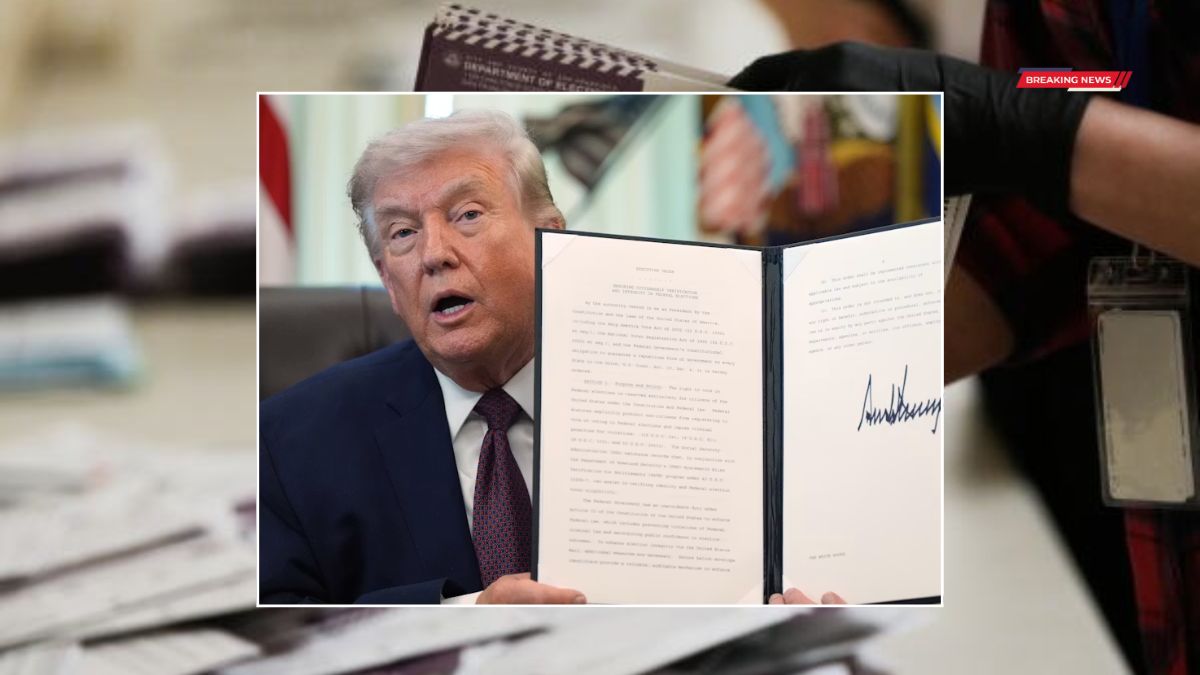
A federal judge in Boston on Thursday blocked the Trump administration from enforcing key provisions of an executive order that would have imposed stricter rules on mail-in voting and required the creation of a federal list of eligible voters for every state.
U.S. District Judge Indira Talwani ruled that the administration cannot implement two central parts of the order, which was signed by President Trump in March. The decision represents a significant setback for the administration’s efforts to expand federal oversight of voter eligibility and mail-in ballot distribution.
Ruling
Judge Talwani issued a 37-page opinion siding with 23 states and the District of Columbia, which filed a lawsuit challenging the order. The states argued that the executive branch lacks authority to regulate voter rolls and mail-in voting, powers that are traditionally reserved for states under the Constitution.
Talwani agreed, concluding that neither Congress nor the president has the legal authority to create or control voter eligibility databases. She said federal agencies are not equipped to compile accurate and comprehensive lists of eligible voters across all states.
“It is clear that the federal agencies charged with compiling Confirmed Citizen Lists lack the ability to create complete and accurate lists of the U.S. citizens residing in every state,” Talwani wrote.
Executive Order Details
The executive order directed Homeland Security Secretary Markwayne Mullin to compile voter eligibility lists using data from the Social Security Administration. It also instructed the U.S. Postal Service to deliver absentee ballots only to individuals included on federally prepared and approved mail-in ballot lists.
In addition, the order told the attorney general to prioritize investigations and possible prosecutions of state and local officials who conduct elections without using the federally approved lists.
Talwani said these measures exceeded the authority of the executive branch and posed risks to the administration of elections at the state level.
Constitutional Authority
The judge emphasized that Congress has not authorized the federal government to create its own national voting database. Instead, she said, federal law leaves voter eligibility decisions to the states, consistent with constitutional principles.
“In no federal statute does Congress authorize the federal government to create their own voting database,” Talwani wrote. “The president lacks any authority to compile voter lists for each state.”
She added that the proposed federal list could be used as an enforcement tool that might discourage local election officials from fulfilling their legal duties to ensure eligible voters can participate.
Postal Service Role
Talwani also addressed the executive order’s impact on the Postal Service, stating that no law grants USPS authority to regulate mail-in voting. She said the order’s requirement that states use a specific federal mail-in ballot list conflicts with established USPS rulemaking procedures.
Her ruling came a day after Postmaster General David Steiner testified before the Senate Homeland Security Committee. Steiner said the Postal Service was considering a rule under which it would refuse to deliver mail-in ballots in states that do not provide approved voter lists to the federal government.
Conflicting Court Decisions
The Boston ruling follows a separate decision last month by U.S. District Judge Carl Nichols in Washington, D.C., who declined to block the executive order in a lawsuit brought by the Democratic National Committee and affiliated groups. Nichols found that the plaintiffs lacked standing at the time and failed to demonstrate immediate harm.
Nichols, a Trump appointee, said the groups could renew their challenge once the administration issued additional rules to implement the order. The plaintiffs have since appealed that decision.
Next Steps
The White House and the Justice Department have not yet publicly responded to the Boston ruling. The decision is likely to be appealed and could eventually be reviewed by higher courts, adding to ongoing legal debates over federal and state authority in election administration.
For now, Talwani’s order prevents the Trump administration from moving forward with plans to centralize voter eligibility lists and condition mail-in ballot delivery on federal approval.
FAQs
What did the judge block?
Key parts of Trump’s mail-in voting executive order.
Who issued the ruling?
U.S. District Judge Indira Talwani.
What was the order meant to do?

Create federal voter lists and limit mail-in ballots.
Why did states sue?
They argued the order violated state authority.
Can the ruling be appealed?
Yes, the decision can be challenged in higher courts.