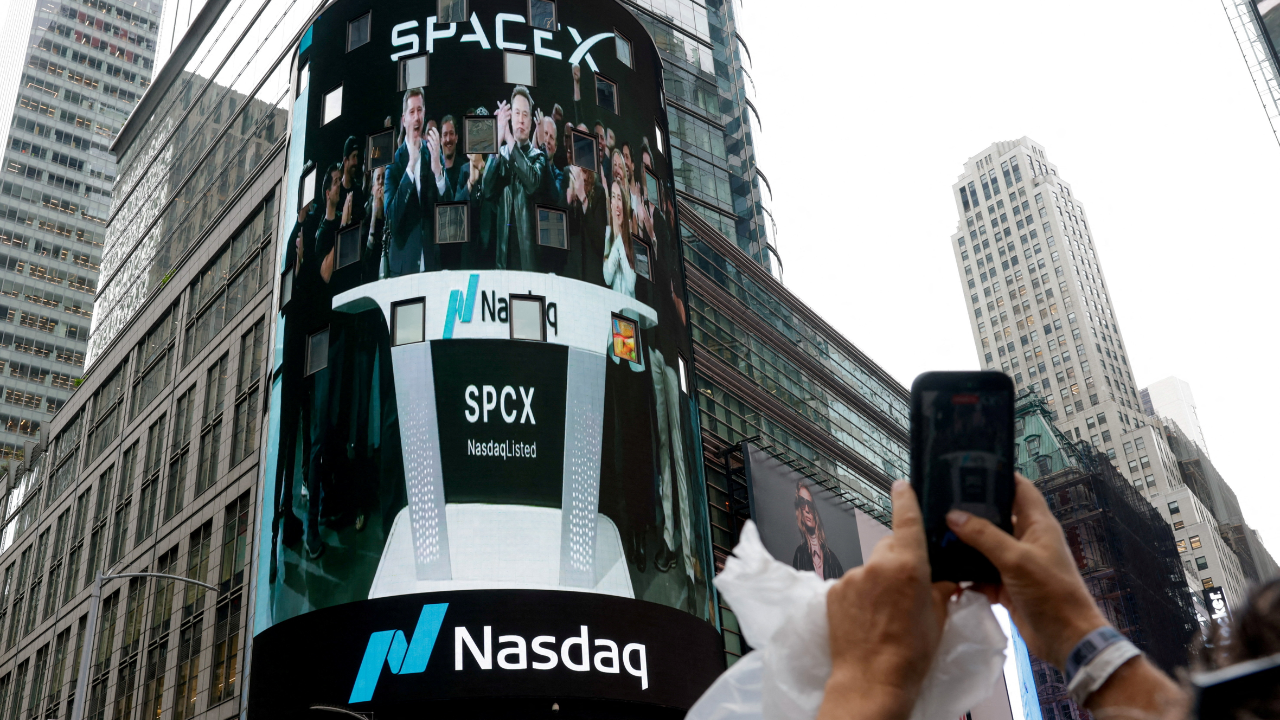
LOS ANGELES, California — SpaceX shares experienced a sharp decline in Thursday trading, marking a sudden shift in momentum after a record-breaking IPO debut the previous week. The drop has raised concerns among investors who had initially driven strong demand and rapid price appreciation following the company’s highly anticipated market entry.
The aerospace and space technology giant had seen significant enthusiasm from institutional and retail investors during its IPO launch, fueled by optimism about its dominance in commercial space exploration, satellite deployment, and government contracts. However, the latest downturn suggests early volatility in what had been considered one of the most closely watched public offerings in recent years.
Post-IPO Surge and Market Expectations
SpaceX entered the public market with extraordinary attention, benefiting from strong brand recognition and its reputation as a leader in private space exploration. The IPO debut was widely described as record-breaking due to the level of investor demand and the rapid increase in share value during the initial trading sessions.
Market analysts noted that early trading enthusiasm was driven by expectations of long-term growth in space infrastructure, satellite internet services, and defense-related aerospace contracts. Many investors viewed SpaceX as a future-defining company with the potential to reshape global communications and space travel.
However, such rapid early gains often lead to profit-taking behavior, where investors sell shares to lock in returns after an initial surge, creating downward pressure on stock prices.
Reasons Behind the Sharp Share Decline
The sudden fall in SpaceX shares on Thursday is largely attributed to a combination of profit-taking, market correction, and investor reassessment of valuation levels following the IPO surge. After the initial excitement, some traders began questioning whether the stock had risen too quickly relative to near-term financial performance.
Broader market conditions may have also contributed to the decline, as technology and growth stocks often experience volatility in response to interest rate expectations and macroeconomic uncertainty. Investors tend to react quickly to shifting financial signals, particularly in newly listed companies with high valuations.
Additionally, early IPO trading often experiences “cooling phases,” where volatility stabilizes after initial excitement fades and the market seeks a more sustainable price range.
Investor Sentiment and Market Reactions
Investor sentiment toward SpaceX remains mixed following the decline. While long-term confidence in the company’s technological leadership remains strong, short-term traders appear cautious after the sudden drop in share value.
Some analysts argue that the decline represents a healthy market correction rather than a structural weakness in the company’s fundamentals. They suggest that early post-IPO volatility is common, especially for high-profile companies with strong retail investor participation.
Others warn that continued fluctuations may indicate uncertainty about how quickly SpaceX can translate its technological dominance into consistent public market earnings growth.
SpaceX Business Outlook and Growth Drivers
Despite the stock decline, SpaceX continues to maintain strong operational momentum in its core business segments. The company remains a leader in reusable rocket technology, satellite deployment through its Starlink network, and commercial launch services for government and private clients.
Long-term growth expectations are still tied to expansion in global satellite internet coverage and increasing demand for low-cost space launches. SpaceX’s partnerships with government agencies and commercial clients also provide a stable revenue foundation that supports long-term investor confidence.
However, analysts emphasize that translating these strengths into consistent public market performance will take time, especially as the company adjusts to the expectations and scrutiny of being publicly traded.
Volatility After Major IPO Listings
The sharp decline in SpaceX shares is consistent with historical trends seen in other high-profile IPOs. Newly listed companies often experience extreme volatility in the first weeks of trading as markets attempt to establish fair valuation levels.
Early rallies are frequently followed by corrections as investors reassess risk, lock in profits, or respond to broader market conditions. This pattern is especially common in technology and innovation-driven sectors where future growth expectations play a major role in pricing.
Experts suggest that SpaceX’s current volatility is not unusual and may stabilize as trading activity matures and institutional investors take a more dominant role in pricing the stock.
Key Market Details
| Category | Details |
|---|---|
| Company | SpaceX |
| Location | Los Angeles, California, United States |
| Event | Post-IPO share decline |
| Market Action | Sharp drop in Thursday trading |
| Previous Event | Record-breaking IPO debut last week |
| Investor Behavior | Profit-taking and volatility response |
| Sector | Aerospace and space technology |
| Key Assets | Starlink, rocket launch services, satellite infrastructure |
| Market Trend | Early IPO volatility and correction phase |
| Outlook | Long-term growth positive, short-term uncertain |
The sharp decline in SpaceX shares following its record-breaking IPO debut highlights the volatility that often accompanies newly listed high-growth companies. While early investor enthusiasm drove significant gains, the recent drop reflects a natural market correction as traders reassess valuations and secure profits.
Despite the short-term fluctuation, SpaceX continues to hold strong long-term growth potential driven by its leadership in space technology, satellite communications, and commercial launch services. As the market stabilizes, investors are expected to gain a clearer picture of the company’s sustainable valuation and performance trajectory.
FAQ’s:
Why did SpaceX shares fall after the IPO?
The decline is mainly due to profit-taking and market correction after a strong initial surge.
Was the IPO successful?
Yes, the IPO debut was described as record-breaking with strong investor demand.
Is SpaceX still growing as a company?

Yes, it continues to expand in satellite services, rocket launches, and space technology.
Is this kind of drop normal after IPOs?
Yes, early IPO volatility and price corrections are common in the market.
What is SpaceX’s long-term outlook?
Analysts remain positive about long-term growth despite short-term market fluctuations.