
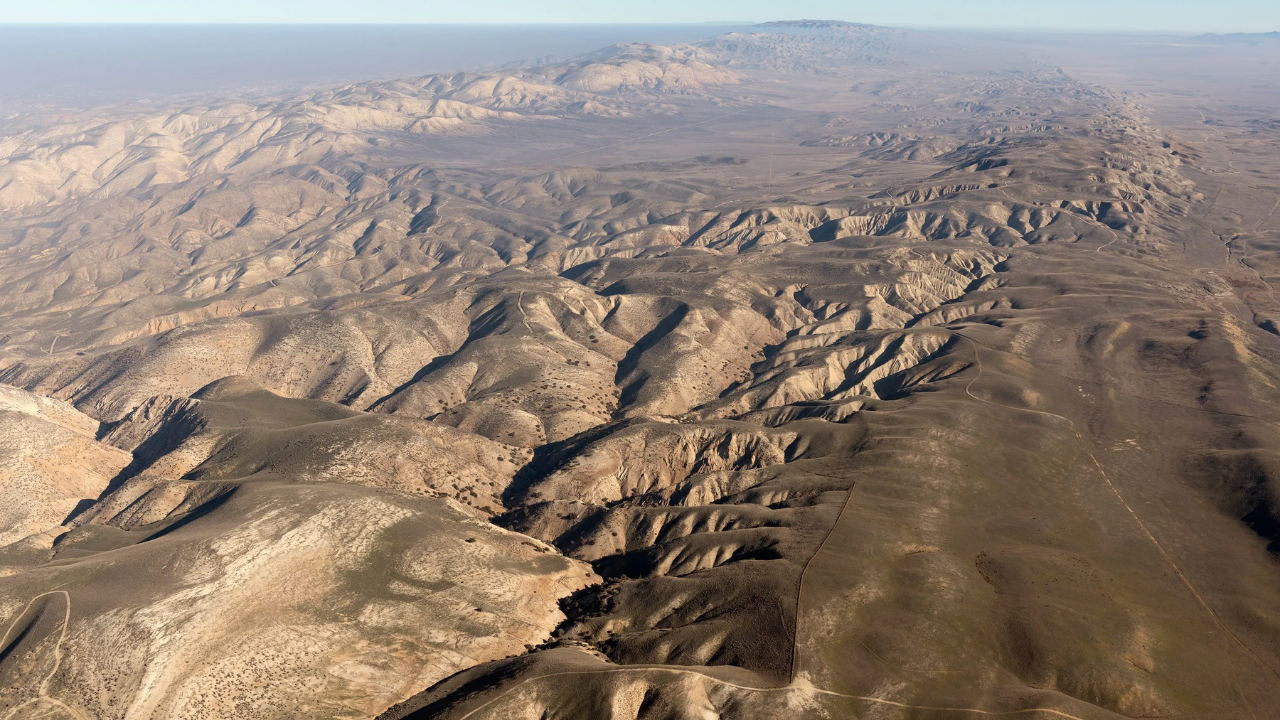
CALIFORNIA — Scientists monitoring seismic activity along the San Andreas Fault have reported that tectonic stress levels may be at their highest point in roughly 1,000 years, raising renewed concerns about the possibility of a major earthquake rupture in the state. The findings come from long-term geological and seismic research analyzing fault movement, strain accumulation, and historical earthquake cycles.
The San Andreas Fault, which runs approximately 800 miles through California from the Salton Sea in the south to Cape Mendocino in the north, is the boundary between the Pacific and North American tectonic plates. It is capable of producing powerful earthquakes, including so-called “megathrust-style” ruptures in certain segments.
Researchers say the latest data suggests that strain buildup along several sections of the fault has reached unusually high levels, increasing the likelihood of significant seismic release in the future.
What Scientists Found Along the Fault Line
According to geological analysis, stress accumulation along the San Andreas Fault has been building over centuries due to the constant movement of tectonic plates. The Pacific Plate moves northwest relative to the North American Plate at an average rate of about 2 inches per year, but friction along locked sections of the fault prevents smooth movement.
This locked energy gradually builds until it is released in the form of earthquakes. Scientists studying sediment records, fault trenching, and GPS deformation data have identified patterns suggesting that certain segments of the fault have not released major energy in hundreds of years.
Some researchers believe that the southern section of the fault, often referred to as the “Big Bend” region, is particularly concerning due to its geometry, which increases compressional stress. The analysis suggests that accumulated strain may now be comparable to or greater than levels seen before major historical earthquakes in California’s recorded geological history.
While no specific earthquake timing can be predicted, the study emphasizes that long periods of stress accumulation typically increase long-term rupture probability.
Earthquake Risk and the San Andreas Fault System
The San Andreas Fault is one of the most closely studied fault systems in the world due to its history of producing large and destructive earthquakes. Major past events include the 1906 San Francisco earthquake, which caused widespread destruction and significant loss of life, and the 1857 Fort Tejon earthquake, which ruptured a large portion of the southern fault.
Scientists divide the fault into multiple segments, each with different levels of seismic risk. Some sections, such as those near Los Angeles and the southern inland regions, are considered “locked,” meaning they have not experienced significant movement in a long time and are therefore accumulating strain.
The concern raised by recent findings is that multiple segments may now be approaching a critical threshold simultaneously. If a large rupture were to occur, it could potentially trigger cascading effects along adjacent sections of the fault.
Experts stress that while increased stress does not guarantee an immediate earthquake, it does indicate a higher long-term probability of a major seismic event.
Monitoring, Preparedness, and Scientific Uncertainty
Despite alarming interpretations of stress levels, seismologists emphasize that earthquake prediction remains impossible with current scientific tools. Instead, researchers rely on probability models, historical recurrence intervals, and real-time monitoring systems to assess risk.
The California Integrated Seismic Network (CISN), along with the United States Geological Survey (USGS), continuously monitors fault movement using GPS stations, satellite imaging, and underground sensors. These systems track minute shifts in the Earth’s crust to better understand how stress is distributed along fault lines.
Emergency management agencies across California regularly conduct earthquake preparedness campaigns, including public drills and infrastructure reinforcement guidelines. Officials emphasize that preparedness remains the most effective strategy in a region with unavoidable seismic risk.
Building codes in California are among the strictest in the world, designed to reduce structural damage and protect lives during major earthquakes. However, scientists warn that a large-scale rupture on the San Andreas Fault would still have significant consequences, particularly in densely populated areas.
Key Facts About the San Andreas Fault Study
| Category | Details |
|---|---|
| Location | San Andreas Fault, California, USA |
| Fault Length | Approximately 800 miles |
| Tectonic Plates | Pacific Plate & North American Plate |
| Main Finding | Stress levels possibly highest in ~1,000 years |
| Risk Type | Potential major earthquake rupture |
| Key Agencies | USGS, California seismic research institutions |
| Historical Events | 1906 San Francisco earthquake, 1857 Fort Tejon earthquake |
| Monitoring Tools | GPS, seismic sensors, satellite imaging |
| Prediction Status | No precise earthquake prediction possible |
| Public Concern | Elevated long-term seismic risk |
The latest scientific analysis of the San Andreas Fault highlights a significant buildup of tectonic stress that researchers say could be among the highest seen in a millennium. While this does not indicate an immediate earthquake, it reinforces long-standing concerns about California’s vulnerability to major seismic events.
Experts continue to emphasize that earthquake science is focused on risk assessment rather than precise forecasting. As monitoring technology improves, scientists hope to better understand how and when accumulated stress may eventually be released.
For now, the findings serve as a reminder of the importance of preparedness, resilient infrastructure, and ongoing scientific research in one of the world’s most active earthquake zones.
FAQ’s:
What is the San Andreas Fault?
It is a major tectonic fault line in California where the Pacific and North American plates meet.
Why is it considered dangerous?
Because it is capable of producing large earthquakes due to accumulated tectonic stress.
Can scientists predict when it will rupture?

No, exact earthquake timing cannot currently be predicted.
What does “stress buildup” mean?
It refers to energy accumulating in the Earth’s crust due to blocked tectonic movement.
What should California residents do?
Experts recommend having emergency plans, supplies, and awareness of earthquake safety procedures.

















Ariana Grande Plans Break From Public Spotlight After Tour Amid Ongoing Scrutiny