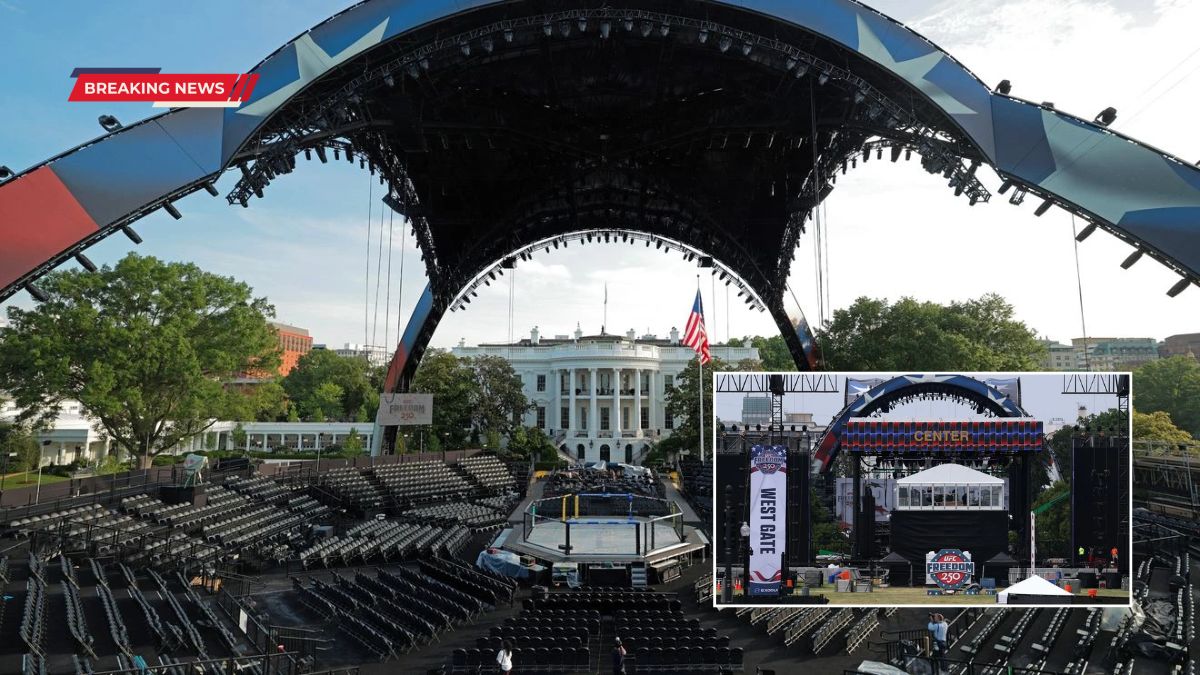
Washington, D.C. is preparing to host a large national exhibition tied to America’s 250th anniversary, but the event has already encountered early challenges as several states reconsider or decline participation. The Great American State Fair, promoted as a multi-day celebration of American history, culture, and regional identity on the National Mall, is now facing questions about cost, coordination, and political perception as the opening date approaches.
Scheduled for June 25 through July 10, 2026, the event is expected to feature state pavilions, performances, cultural exhibits, military demonstrations, and family attractions. However, a growing list of states, including Oregon, Washington, North Carolina, Massachusetts, Illinois, and Connecticut, have indicated they will not send official resources or staff, or are shifting focus toward in-state celebrations.
The Great American State Fair was designed as a large-scale national exposition marking the 250th anniversary of the United States. Organizers have described it as a World’s Fair-style gathering hosted on the National Mall, with each state invited to present exhibits reflecting its history, economy, and culture.
The concept was intended to bring together all 50 states in a shared civic celebration. However, participation has become uneven as states evaluate financial costs and logistical demands. Reports suggest that additional states beyond those already named are also reassessing their involvement, though final participation lists remain fluid.
States
Oregon and Washington were among the first states to publicly confirm they would not take part in the event in its planned format. Their decisions were later followed by similar announcements or indications from North Carolina, Connecticut, Massachusetts, and Illinois.
In most cases, states have not described their decisions as opposition to the national anniversary itself. Instead, officials have emphasized resource allocation and a preference for local programming connected to America 250 commemorations within their own states.
This has created a fragmented participation picture, with some states continuing planning efforts while others redirect funding and staffing toward regional events.
Reasons
State-level explanations for stepping back from the fair vary, but generally fall into two categories: cost and program alignment.
Several states have pointed to the financial demands of participating in a large-scale event in Washington, D.C. Expenses include exhibit design, shipping materials, staffing, travel, lodging, and ongoing operational costs during the two-week schedule. Even modest installations can require significant budget commitments when transported and maintained far from home.
Officials have also emphasized that state-run America 250 programs can be delivered more directly to residents through local museums, civic events, and educational initiatives. This has been presented as a more accessible and cost-effective alternative to a national pavilion.
Cost
Financial considerations appear to be a central factor in participation decisions. In Oregon’s case, officials reportedly cited shipping costs alone that could reach tens of thousands of dollars, with some estimates around $70,000 before additional expenses are included.
Connecticut has also been cited in reports as facing potential participation costs of up to $100,000. While such amounts vary in significance depending on a state’s overall budget, they often require justification during planning cycles that prioritize education, infrastructure, housing, and public safety.
For Washington state, officials indicated that resources would be better used supporting in-state commemorations rather than funding a distant exhibit. This reflects a broader budgeting approach in which states weigh symbolic national presence against direct local impact.
Politics
Beyond financial considerations, some states have raised concerns about the perception of the event itself. Officials in Oregon, for example, referenced concerns that the fair may be perceived as politically aligned rather than strictly nonpartisan.
This perception issue has become a key factor for states trying to balance participation in national celebrations with maintaining neutral branding in their own public programming. Even when events are framed as cultural or historical, political associations can influence public reception and legislative support for funding.
At the center of this concern is how the fair is being presented and perceived, particularly given its association with a current political administration. For some state officials, the question is not the importance of the 250th anniversary, but how best to participate in a way that avoids political interpretation.
National Mall
The choice of the National Mall as the event site adds symbolic weight and logistical complexity. The Mall is one of the most historically significant public spaces in the United States, home to national monuments, memorials, and museums.
Hosting a state fair-style event in this location elevates expectations for scale, inclusivity, and national representation. It also increases visibility, meaning participation decisions carry greater public attention than they might at a regional venue.
Because the Mall is closely associated with national identity and historical memory, any perception of uneven participation becomes part of the broader narrative of the event itself.
Impact
The withdrawal or hesitation of multiple states introduces uncertainty into what was intended to be a unifying national exhibition. While the event is still expected to proceed, the absence of official state participation from several regions could reshape how the fair is experienced and interpreted.
Organizers still anticipate large attendance and a full schedule of programming, including cultural displays, entertainment, and educational exhibits. However, the overall framing of the event has shifted from a guaranteed nationwide showcase to a more contested and evolving project.
At the same time, states that are opting out are continuing to develop their own America 250 initiatives. These include local festivals, museum exhibits, historical reenactments, and community-based programs designed to reach residents directly.
The early response to the Great American State Fair highlights a broader tension between national symbolism and state-level priorities. While the event is designed to mark a shared milestone in American history, participation decisions are being shaped by budget constraints, logistical considerations, and concerns about political perception. As planning continues, the final composition of the event remains uncertain, reflecting the complexity of organizing a nationwide celebration in a politically divided environment.
FAQs
What is the Great American State Fair?
It is a planned national exhibition in Washington, D.C. for America’s 250th anniversary.
Which states are stepping back?
Oregon, Washington, North Carolina, Connecticut, Illinois, and others.
Why are states withdrawing?

Main reasons include cost concerns and local programming priorities.
Where will the event be held?
On the National Mall in Washington, D.C.
Is the event still happening?
Yes, it is still scheduled for June to July 2026.