
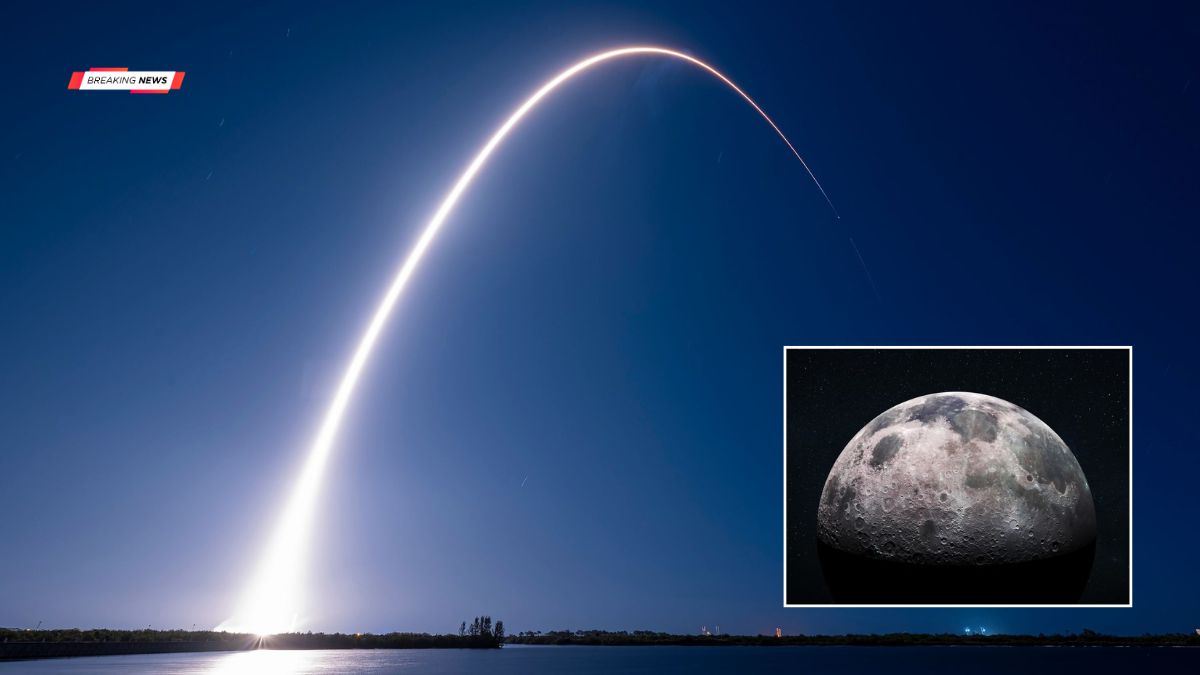
An abandoned SpaceX rocket stage is expected to collide with the Moon in the early hours of August 5 (UTC), creating a new crater on the lunar surface. While the impact itself poses no danger to Earth, scientists say it highlights a growing challenge: how to manage increasing human activity on the Moon as governments and private companies expand lunar exploration.
Impact
The rocket stage was launched in January 2025 to deliver two commercial lunar landers toward the Moon.
After completing its mission, the rocket did not have enough fuel to return to Earth or move into deep space. Instead, it remained in an unstable orbit until the Moon’s gravity gradually pulled it onto a collision course.
The impact is expected to occur at approximately 8,700 kilometers per hour.
| Mission Details | Information |
|---|---|
| Launch Date | January 2025 |
| Object | SpaceX rocket stage |
| Expected Impact | August 5 (UTC) |
| Impact Speed | About 8,700 km/h |
Science
Researchers view the collision as an uncommon scientific opportunity.
Because scientists know the rocket’s approximate size, speed, and expected impact location, they can compare observations with computer models that simulate lunar impacts.
The event is expected to create a crater measuring roughly 20 to 30 meters across while ejecting lunar dust, known as regolith, several kilometers above the Moon’s surface.
The findings could improve future research into crater formation and the behavior of lunar soil during impacts.
Environment
Unlike Earth, the Moon has virtually no atmosphere and no weather capable of erasing surface changes.
As a result, impact craters, spacecraft remains, and even astronaut footprints can remain visible for thousands of years.
The Apollo mission footprints left more than five decades ago are still preserved, illustrating how long human activity can remain visible on the lunar surface.
Concerns
Scientists say the larger issue extends beyond a single impact.
As more countries and private companies launch missions to the Moon, activities such as landings, rover operations, and construction projects could unintentionally affect nearby equipment or historically significant locations.
Potential risks include:
- Dust damaging scientific instruments
- Interference with lunar infrastructure
- Damage to historic Apollo landing sites
- Disruption of ongoing research
- Risks to future crewed missions
The upcoming SpaceX impact is expected to occur near the relatively isolated Einstein Crater, reducing the likelihood of affecting existing lunar sites.
Law
International space activities are primarily governed by the 1967 Outer Space Treaty.
The treaty states that no nation may claim ownership of the Moon and that lunar exploration should benefit all humanity. However, it provides limited guidance on managing environmental impacts or coordinating growing numbers of lunar missions.
Responsibility for supervising commercial space companies generally falls to the governments that authorize their activities.
| Space Governance | Current Situation |
|---|---|
| Governing Treaty | Outer Space Treaty (1967) |
| Moon Ownership | No country may claim sovereignty |
| Environmental Rules | Limited |
| Company Oversight | National governments |
Coordination
Experts suggest that greater international coordination could help reduce future conflicts on the Moon.
Among the ideas being discussed are a voluntary lunar registry where countries identify planned missions, infrastructure, and culturally significant sites, as well as standardized notices that would inform other operators about planned landings and activities.
The United Nations Office for Outer Space Affairs (UNOOSA) and the United Nations Committee on the Peaceful Uses of Outer Space are already examining ways to improve cooperation as lunar exploration expands.
Outlook
The upcoming impact is not expected to threaten Earth or interfere with current lunar operations. However, it serves as a reminder that human activity on the Moon is increasing rapidly.
As more spacecraft travel to the lunar surface, experts say effective coordination, information sharing, and international cooperation will become increasingly important to help protect scientific research, historic sites, and future missions.
The SpaceX rocket’s collision with the Moon will provide valuable scientific data while also highlighting the need for clearer guidelines governing future lunar activities. As exploration accelerates, balancing scientific progress with responsible stewardship of the Moon is likely to become an increasingly important international discussion.
FAQs
When will the SpaceX rocket hit the Moon?
The impact is expected in the early hours of August 5 (UTC).
Does the impact pose any danger to Earth?
No. The collision is expected to affect only the Moon.
Why is the impact scientifically important?

It will help scientists study crater formation and lunar dust.
Who governs activities on the Moon?
The 1967 Outer Space Treaty provides the main legal framework.
Why are experts calling for more coordination?
To help protect lunar missions, equipment, and historic sites.