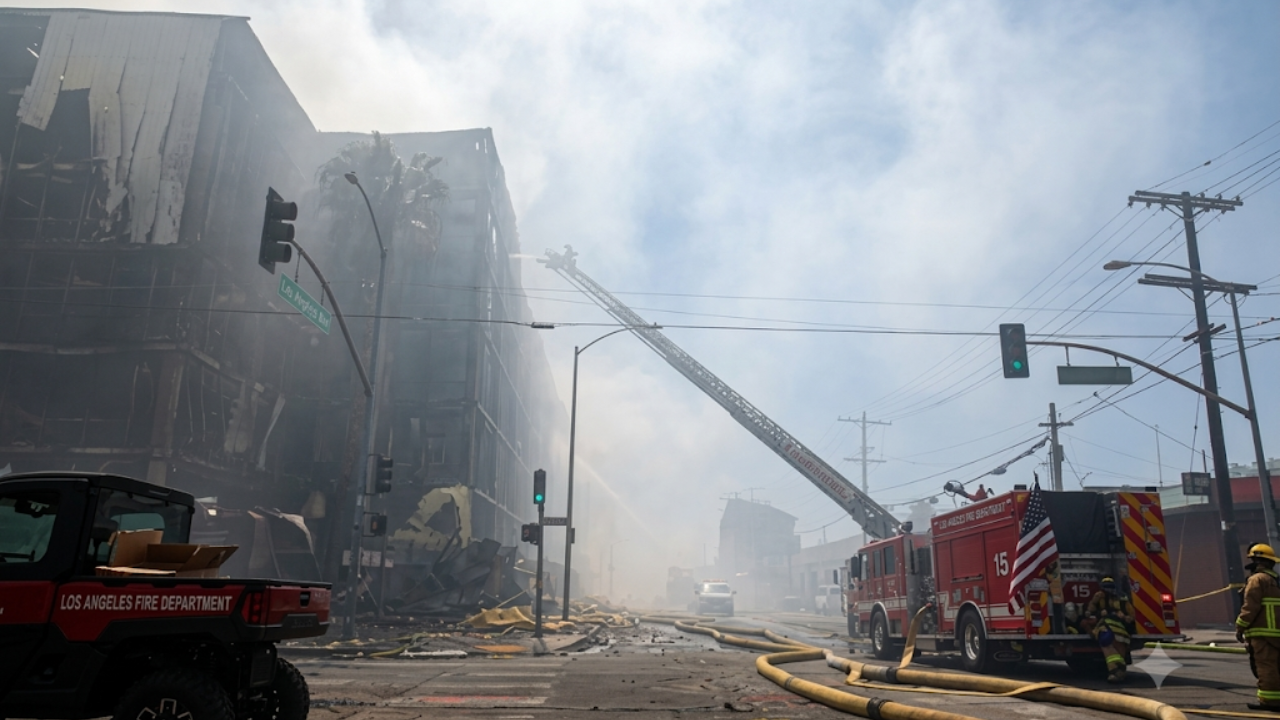
LOS ANGELES, California — A large warehouse fire in Los Angeles has continued burning for several days, prompting widespread concern from residents and raising questions about why firefighters have struggled to fully extinguish the blaze. The fire, which broke out at an industrial storage facility, has required continuous firefighting operations as crews battle intense heat, structural collapse risks, and deep-seated flames within the building.
Authorities say the prolonged nature of the fire is due to a combination of structural conditions, combustible materials inside the warehouse, and limited safe access points for firefighters. While crews have managed to contain portions of the blaze, hotspots continue to reignite within the structure, preventing full extinguishment.
The incident has become one of the more complex fire responses in the region in recent months, highlighting challenges faced by fire departments when dealing with large-scale industrial fires in dense urban environments.
Firefighters Face Structural Collapse and Intense Heat
One of the primary challenges in extinguishing the warehouse fire has been the structural instability of the building. Fire officials report that sections of the warehouse have already collapsed or become too dangerous to enter, limiting the ability of firefighters to attack the blaze directly from the inside.
High heat levels inside the structure have also made conditions extremely hazardous. As the fire continues to burn through stored materials, it generates intense heat pockets that can rapidly shift and spread within the building. Firefighters have had to rely heavily on defensive strategies, using water streams and aerial equipment from outside the structure rather than entering the building itself.
Officials explain that when a fire reaches this stage, it often transitions from an interior attack to a prolonged containment operation. This means crews must carefully monitor the structure, prevent the fire from spreading to nearby buildings, and wait for conditions to become safe enough to access remaining hotspots.
The unstable environment significantly slows progress, as firefighter safety remains the top priority during extended operations.
Highly Combustible Materials Fuel Ongoing Flames
Investigators and fire officials have indicated that the warehouse contained a variety of stored materials that contributed to the fire’s intensity and duration. Industrial warehouses often house goods such as packaging materials, plastics, textiles, and other flammable items that can accelerate fire growth and sustain burning over long periods.
Once ignited, these materials can create deep-seated fires that are difficult to reach with standard firefighting techniques. Even after surface flames are controlled, hidden pockets of fire may continue burning inside stacked goods or collapsed debris.
Firefighters have reportedly been working to break apart sections of the warehouse in order to expose and extinguish these hidden hotspots. However, this process is slow and labor-intensive, especially when heavy machinery must be used cautiously to avoid further structural collapse.
Wind conditions and airflow within the partially destroyed building may also contribute to fire spread, making it difficult to fully suppress all active areas at once. As a result, crews must repeatedly revisit sections of the site to ensure the fire does not reignite.
Extended Response Reflects Complexity of Urban Industrial Fires
The multi-day response highlights the complexity of fighting large warehouse fires in urban Los Angeles environments. Fire departments must balance aggressive firefighting tactics with strict safety protocols while also managing traffic control, air quality concerns, and potential impacts on nearby residential and commercial areas.
Extended firefighting operations require rotating crews, continuous water supply logistics, and coordination between multiple emergency units. Firefighters often work in shifts around the clock to maintain pressure on the fire while preventing exhaustion and ensuring safety.
Officials also note that environmental and structural assessments may be necessary before full extinguishment can be achieved. In some cases, heavy equipment is used to dismantle portions of a structure to allow better access to burning materials, but this must be done carefully to avoid triggering additional collapses.
The incident has also raised broader concerns about warehouse safety standards, fire prevention measures, and emergency preparedness in industrial zones located near populated areas. Investigators are expected to review building conditions, storage practices, and possible ignition sources once the fire is fully extinguished.
Fire Incident Overview
| Detail | Information |
|---|---|
| Location | Los Angeles, California |
| Incident Type | Warehouse Fire |
| Duration | Multi-Day Ongoing Fire |
| Structure Type | Industrial Storage Facility |
| Primary Challenge | Structural Collapse Risk |
| Fuel Source | Combustible Stored Materials |
| Firefighting Strategy | Defensive and External Attack |
| Key Issue | Deep-Seated Hotspots |
| Status | Partially Contained, Not Fully Extinguished |
| Investigation | Pending After Extinguishment |
The warehouse fire burning in Los Angeles for several days underscores the challenges firefighters face when dealing with large-scale industrial blazes. Structural instability, highly combustible materials, and limited access have all contributed to the extended duration of the incident, requiring sustained and cautious firefighting efforts.
While crews have managed to contain portions of the fire, persistent hotspots continue to delay full extinguishment. Officials emphasize that safety remains the top priority as firefighters work through hazardous conditions to bring the blaze under control.
Once the fire is fully extinguished, investigators are expected to examine its origin and contributing factors, including storage conditions and building safety compliance. Until then, firefighting operations will continue as authorities work to fully eliminate remaining fire risks and secure the site.
FAQ’s:
Where is the fire located?
The fire is located at an industrial warehouse site in Los Angeles, California.
Why has the fire been burning for so long?
Structural instability, combustible materials, and hidden hotspots have made the fire difficult to fully extinguish.
Are firefighters inside the building?

In many areas, conditions are too dangerous for interior operations, so crews are using external firefighting methods.
Has the fire been contained?
The fire is partially contained, but it has not been fully extinguished due to ongoing hotspots.
What happens after the fire is out?
Authorities will investigate the cause of the fire and examine building conditions and safety practices.