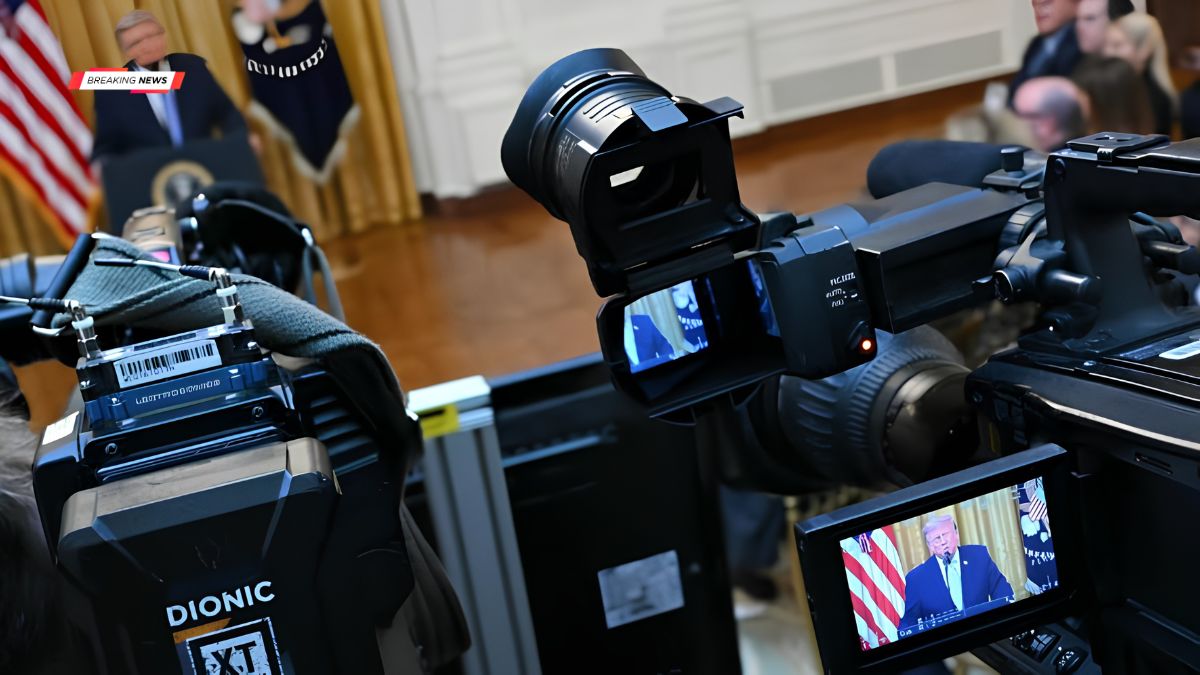
The decision by CBS News to broadcast parts of President Donald Trump’s speech on election fraud has led to discussion among lawmakers, media professionals, and viewers. Senator Mark Warner of Virginia raised concerns about the network’s choice during an appearance on Face the Nation, arguing that the speech included claims that had already been challenged by fact-checkers.
The situation reflects a continuing debate in journalism about how news organizations should cover statements from public officials when those remarks include disputed information. While some believe major political speeches should be available to the public with proper context, others argue that live coverage can unintentionally give additional attention to inaccurate claims.
CBS said its responsibility was to cover an important statement from a sitting president while providing viewers with background and analysis.
Criticism
During his Sunday appearance on Face the Nation, Senator Mark Warner criticized CBS News leadership for deciding to air portions of Trump’s Thursday night speech. He said he respected many journalists at the network but disagreed with the decision made by senior management.
Warner stated that the speech contained several claims about election fraud that he considered false and misleading. He pointed out that other major networks, including ABC, NBC, and CNN, chose not to interrupt their scheduled programming to carry the address live.
CBS joined the speech after it had already started and ended its coverage before the president completed his remarks.
Debate
The response to CBS’s decision highlights a broader issue facing modern news organizations. When a president or major political figure makes a public statement, networks must decide whether the event itself is newsworthy enough for live coverage.
Supporters of live broadcasts argue that viewers should have direct access to important political events and hear statements in their original form. They believe journalists can then provide analysis and corrections.
Critics, however, argue that broadcasting disputed claims requires careful handling because audiences may not always separate the original statement from the later explanation. They believe stronger context should be provided immediately.
This challenge has become increasingly common as news organizations balance speed, transparency, and accuracy.
Coverage
Before CBS aired Trump’s remarks, CBS Evening News anchor Tony Dokoupil provided a warning to viewers about statements related to election fraud. He explained that many previous claims about the 2020 election had been found to be inaccurate.
Dokoupil acknowledged that some people believed airing the speech was the wrong decision. However, he said the speech was going to happen regardless and that covering major events is part of journalism’s role.
CBS’s approach was to broadcast the remarks while also including discussion and criticism from political figures and analysts.
Response
During the special coverage, Warner continued questioning CBS’s decision. He told Dokoupil that journalists have a responsibility to challenge false claims and provide viewers with accurate information.
Warner said news organizations play an important role in protecting public understanding, especially when political statements contain disputed information.
Dokoupil defended the coverage by explaining that Warner’s appearance itself provided the context and criticism being requested. He said the discussion demonstrated that CBS was allowing different viewpoints and analysis on an important issue.
The exchange showed the ongoing tension between two views of political reporting: one that prioritizes direct access to major events and another that emphasizes additional explanation before presenting them to audiences.
Changes
The discussion comes during a period of change at CBS News. Bari Weiss became editor-in-chief after being appointed by Paramount CEO David Ellison, leading to questions about the network’s editorial direction.
Some critics have questioned whether recent leadership decisions represent a shift in CBS’s approach to political reporting. Supporters of the changes argue that the network is working to develop a broader and more independent style of journalism.
The decision to air Trump’s speech has become part of that larger conversation about how CBS approaches political coverage.
Impact
The controversy surrounding CBS’s coverage reflects the challenges facing news organizations in a highly divided media environment. Audiences increasingly expect news outlets to provide both immediate information and clear explanations about accuracy and context.
For broadcasters, covering political speeches can be a difficult decision. Providing access to major events may support transparency, while failing to address inaccurate statements can create concerns about public understanding.
As political communication continues to evolve, networks will continue to face decisions about how to report on statements from influential figures while maintaining journalistic standards.
The CBS coverage debate demonstrates the complexity of modern political journalism. News organizations must consider not only what events to cover but also how to present information in a way that helps audiences understand the facts, the context, and the different perspectives involved.
FAQs
Why did Warner criticize CBS?
Warner criticized CBS for airing Trump’s speech with disputed claims.
Did other networks air the speech?
ABC, NBC, and CNN did not provide live coverage of it.
Who leads CBS News?

Bari Weiss serves as CBS News editor-in-chief.
What warning did Dokoupil give?
He warned viewers about disputed election fraud statements.
Why was CBS coverage debated?
The debate focused on covering speeches with false claims.