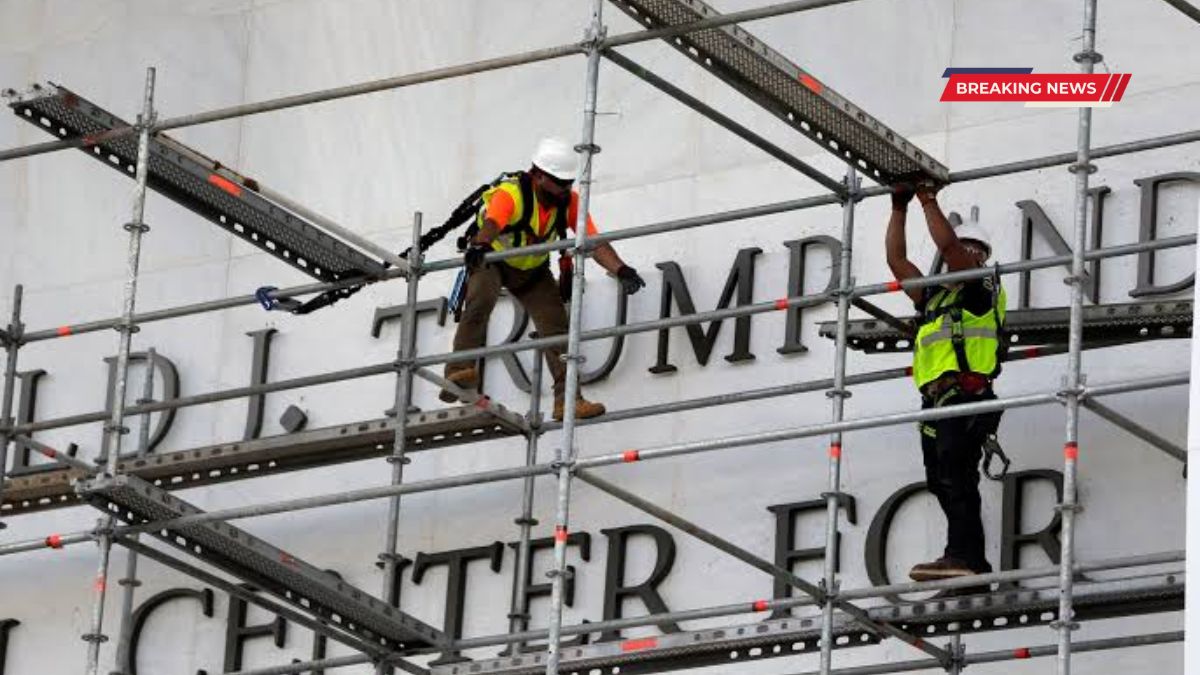
President Donald Trump’s name has been removed from the Kennedy Center building following a court-ordered deadline, marking the end of a brief and contentious chapter in the history of the national performing arts venue. While the removal itself was not immediately visible to the public, court filings confirm that the signage has been taken down in compliance with a federal judge’s order.
Compliance
Matt Floca, the Kennedy Center’s executive director and chief operating officer, told a federal court on Saturday that the institution had fully complied with the order. According to the filing, the board of trustees and the center removed all physical signage on the building and surrounding grounds that renamed the venue after President Trump.
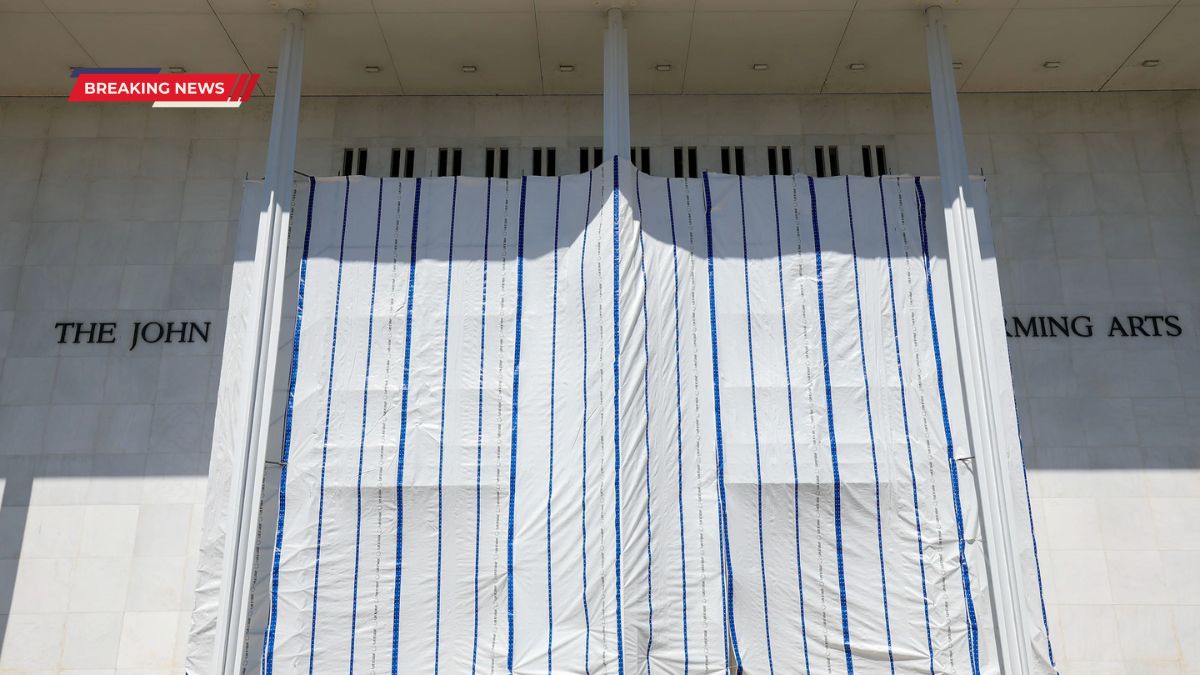
For visitors gathered at the plaza in front of the center, however, there was no clear visual confirmation. A tarp remained draped over scaffolding erected for the work, blocking the facade from view. It was not immediately clear when the tarp would be removed to reveal the original name, The John F. Kennedy Memorial Center for the Performing Arts.
A reporter was able to see through a small opening in the tarp and confirmed that the letters bearing Trump’s name were no longer attached to the building.
Legal Battle
The removal followed a tense legal standoff. The Kennedy Center’s leadership had sought to delay compliance while pursuing an appeal, but both a federal district court and an appeals court rejected last-minute requests to keep Trump’s name in place.
After severe thunderstorms swept through Washington on Friday evening, the institution requested one additional extension before meeting a noon Saturday deadline. That request was also denied, forcing the center to proceed with the removal.
The court order stems from a May ruling that not only required Trump’s name to be removed but also blocked a planned two-year closure of the venue for renovations.
Reaction
Supporters of the lawsuit welcomed the outcome. Rep. Joyce Beatty, D-Ohio, an ex officio member of the Kennedy Center board and the plaintiff who challenged the renaming, was present at the site late Friday and Saturday morning. She later posted a video on social media celebrating the decision.
“Today’s victory is the beginning of returning the Kennedy Center to the American people,” Beatty said in a statement, adding that the ruling demonstrated the strength of the rule of law.
Some members of the public expressed similar sentiments. Leo Bartholomaus, a recent Syracuse University graduate who was visiting the area, said he was unhappy with the decision to add Trump’s name to the building.
“My grandmother had a big love of the arts,” he said. “I’ve been here to see The Lion King. I thought it was better as the Kennedy Center.”
Background
The Kennedy Center was conceived in 1958, began construction in 1964, and was dedicated to the memory of President John F. Kennedy after his assassination. It has long been viewed as one of Washington’s few largely nonpartisan cultural institutions.
After returning to office in January 2025, Trump moved quickly to replace the center’s leadership and install a new board of trustees, which named him chairman. His name was subsequently added to the building, prompting legal and political pushback.
While the court-ordered removal represents a setback for Trump, it comes as he continues to reshape parts of Washington’s physical landscape. During his second term, Trump has overseen the demolition of the East Wing of the White House to make way for a new ballroom, alterations to the Lincoln Memorial Reflecting Pool, and proposed changes to East Potomac Park that could limit public access.
At the same time Trump’s name was being removed from the Kennedy Center, the White House South Lawn was being converted into a venue for a UFC event tied to the upcoming 250th anniversary of American independence and coinciding with the president’s birthday.
What Comes Next
Questions remain about the future of the Kennedy Center. The same court ruling that addressed the naming issue also halted a planned closure for renovations, leaving uncertainty around long-term maintenance and programming.
The center’s near-term schedule includes performances such as Moulin Rouge! The Musical and Bluey’s Big Play, along with a June 28 ceremony honoring comedian Bill Maher with the Mark Twain Award for American Humor. Beyond that, few events are currently listed.
After recent staff reductions, it is unclear how quickly the institution can rebuild a full performance calendar. Trump has said that, following the ruling, he may turn oversight of the Kennedy Center over to Congress and has suggested the venue could even close due to public safety concerns.
In its unsuccessful appeal, the Kennedy Center argued that being forced to remove the signage now, only to possibly reinstall it later if it wins on appeal, would waste time and money. The institution also maintained that the court was interfering with urgent repair needs, including what it described as potentially dangerous structural issues.
For now, Trump’s name is off the building, even if hidden behind a tarp. Whether it returns will depend on the outcome of ongoing legal appeals and broader decisions about the future direction of one of the nation’s most prominent cultural institutions.
FAQs
Why was Trump’s name removed from the Kennedy Center?
A federal court ordered its removal.
Is the signage removal visible to the public?
No, a tarp still covers the facade.
Who challenged the renaming in court?

Rep. Joyce Beatty filed the lawsuit.
Could Trump’s name return later?
Yes, if the center wins its appeal.
Are performances continuing at the Kennedy Center?
Yes, but future scheduling is uncertain.