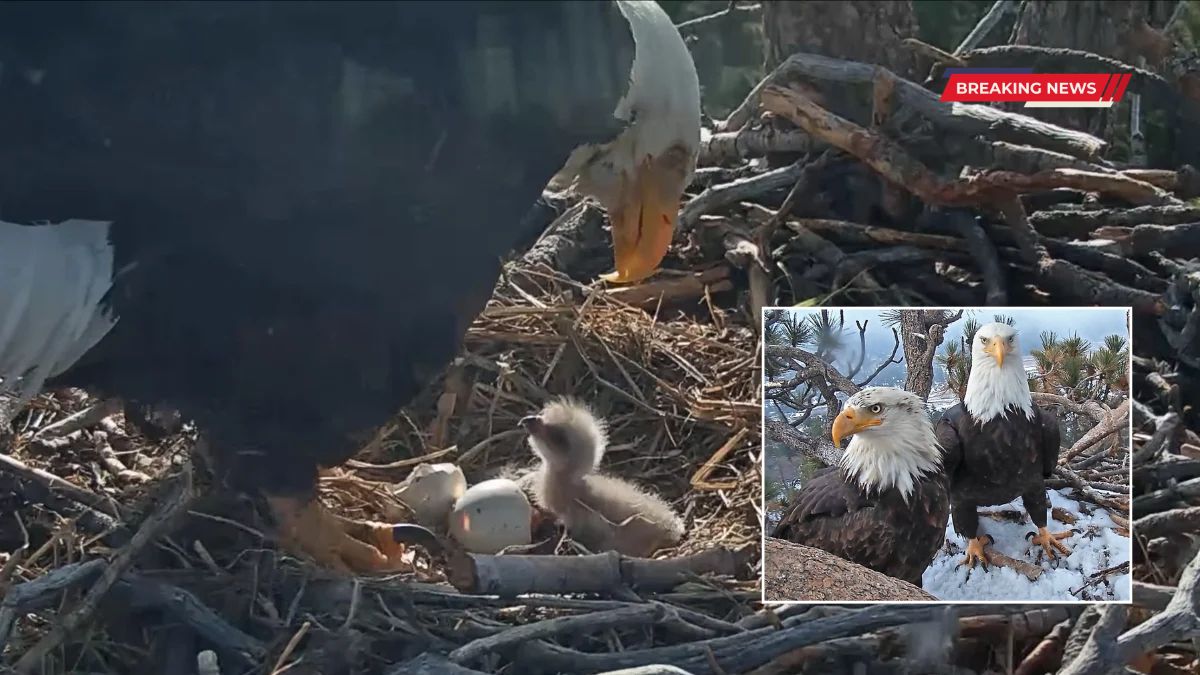
As two well-known bald eagle chicks at Big Bear Lake continue to grow and prepare for flight, officials have confirmed the presence of a new nesting pair of bald eagles in Los Angeles County, marking a notable development for wildlife in Southern California.
The Los Angeles County Department of Parks and Recreation announced Friday, May 29, that a pair of bald eagles has been observed settling into tree branches somewhere within the county. The exact location has not been disclosed to protect the birds.
Confirmation
County officials said the birds appear to be a nesting pair, a rare but encouraging sight in the region.
“We are proud to report that we have a nesting pair of bald eagles in LA County,” the department said in a social media statement.
Bald eagles were once nearly eliminated from much of Southern California due to habitat loss and pesticide exposure. Their return is widely seen by biologists as an indicator of improving environmental conditions.
Location
The county declined to share the specific area where the eagles were spotted. Officials said withholding that information is necessary to reduce the risk of human disturbance.
“Bald eagles, along with all native nesting birds, are protected under federal law,” the department said. “Disturbing active nests can disrupt breeding and impact their success.”
Public Guidance
County officials urged residents and visitors to take steps to avoid interfering with nesting birds, including bald eagles. Recommendations include observing wildlife from a distance, avoiding lingering near nests, and keeping dogs leashed, especially near trees and shrubs.
Officials also advised the public to avoid flying drones near wildlife and to delay tree trimming or vegetation clearing during nesting season whenever possible.
Anyone who encounters a nest or observes a nestling in distress is encouraged to contact their local wildlife agency.
“Protecting wildlife is a shared responsibility,” the department said. “Together, we can help ensure these remarkable birds have the space and support they need to raise the next generation.”
Big Bear Update
The announcement in Los Angeles County comes as attention remains focused on Big Bear Lake in San Bernardino County, where a bald eagle nest belonging to Jackie and Shadow continues to draw a global audience.
Their chicks, Sandy and Luna, hatched on April 4 and April 5 and are now approaching two months of age. The nest, monitored by a 24-hour live camera operated by Friends of Big Bear Valley, has shown the young eagles steadily increasing in size and strength.
Development
According to Friends of Big Bear Valley, Sandy and Luna have been actively exercising their wings and hopping around the nest as they prepare for their first flights. Bald eagle chicks typically fledge, or leave the nest for the first time, at around 10 weeks old.
“Sandy and Luna not only have grown in size, but also in learned skills,” the group said in a statement. “Jackie and Shadow’s parenting skills, coupled with Sandy and Luna’s innate abilities, provide them with what they need to soar.”
Feeding patterns have also begun to change. While the parents remain attentive, feedings have become less frequent as the chicks develop larger crops, which allow them to store food for several days.
Outlook
Wildlife experts say both developments reflect the gradual recovery of bald eagle populations across California. Officials continue to emphasize that human cooperation plays a key role in ensuring the birds’ long-term success.
For now, Sandy and Luna remain under close watch at Big Bear Lake, while the newly confirmed pair in Los Angeles County quietly establishes its presence out of public view.
FAQs
Where was the new bald eagle pair spotted?
In Los Angeles County, though the exact location was not disclosed.
Why is the location being kept secret?
To protect the eagles from disturbance during nesting.
Who are Sandy and Luna?

They are bald eagle chicks at Big Bear Lake.
When do bald eagle chicks usually fledge?
They typically take first flight at around 10 weeks old.
What should people do if they see a nest in distress?
Contact a local wildlife agency.